Author Archives: sammozart

5 Day / 5 Photo Blog Challenge – Bodie Ghost Town

It is my pleasure to take up this 5 Day / 5 Photo Blog Challenge for which my good friend, author and blogger Susan Scott, Garden of Eden Blog, has nominated me.

bodie state historic park
bodie-alley-300-copy

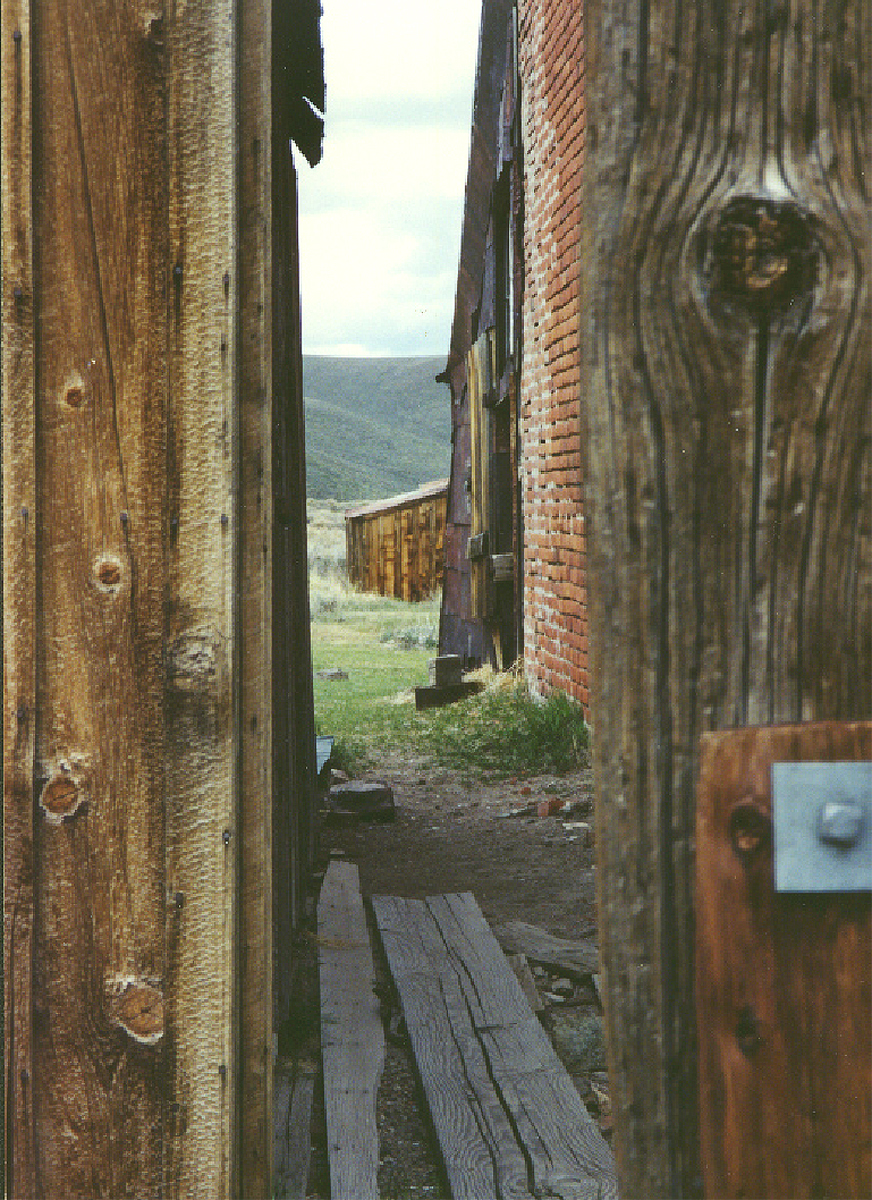
Bodie Alley

Bodie is described as haunting, desolate, captivating. It is. I was there.

Bodie State Historic Park, Calif., is a ghost town, “preserved in a state of arrested decay.” Interiors of the 110 remaining buildings are untouched as they were left, and it looks like some people left in a hurry, their belongings still strewn about.

In 1859 William (Waterman) S. Bodey discovered gold near here. Mr. Bodey didn’t have much time to revel, though, for in November that same year he died in a blizzard.

In 1861 a rich strike was made and a mill was built.  Over the next years the railroad and the telegraph came and the population swelled from 20  to 10,000. It is said there existed three breweries, 65 saloons, an abundance of brothels, a Chinatown, opium dens and a Wells Fargo Bank. There were gunslingers and shootouts. It was a full-on Wild West town. Bodie became the second or third largest California town and one of the earliest United States towns to acquire electricity. The big strikes were soon depleted, though, and the town slid into decline in the 1880s. Miners moved on to Tombstone, Ariz., and other legendary places. Bodie was officially labeled a ghost town in 1915, after the last newspaper closed. The ghost town was designated Bodie State Historic Park in 1962 when the last residents left.

Bodie, just north of Mono Lake, a salt lake, is located at Bridgeport, Calif., near the Nevada border, just below where the eastern border of the state bends to the right. Bodie is northeast of Yosemite and about 75 miles southeast of Lake Tahoe, on high, open hills. The Clint Eastwood movie “High Plains Drifter” was filmed at Mono Lake. The production company built a large façade town at Mono Lake just for the filming.

Even in its boom days, I wonder how residents survived Bodie winters. It is one of the coldest places in the U.S. Up in the Eastern High Sierra Nevada Mountains, elevation 8,375 feet (2,554 m.), where the winds sweep through (up to 100 miles per hour, according to Wikipedia), Bodie has a subarctic climate — temperatures even on summer nights can drop below freezing. The most snow recorded in one month was 97.1 inches in January 1969. Bear in mind, the snow doesn’t melt until spring. The population of Bodie is now a few park rangers and assorted ghosts. The rangers use snowcats to get around through the deep snow. The park is open in the winter, but only to those with skis, snowshoes or snowmobiles. I have visited Bodie in the daytime, in May. I dream of returning with a digital camera to take a nighttime Ghost Walk.

The ghost town is a National Historic Landmark.

The timeline on this site linked below is interesting, plus there are some great photos:

http://www.bodie.com

Here are links to more Bodie history:

http://www.parks.ca.gov/?page_id=509

http://www.yosemitegold.com/yosemite/bodie.html

https://en.wikipedia.org/wiki/Bodie,_California

The movie “Hell’s Heroes,” released in 1929, was filmed in Bodie, just before the second big fire in 1932, leaving Bodie as we see it today:

–Samantha
 

Day Three of 3-Day-Quote Blog Challenge

“Avec le temps”

With time, it goes, everything goes away.

Avec le temps is a poem and song composed by Léo Ferré (24 August 1916 – 14 July 1993). I note that I am composing the draft of this piece on the anniversary of his death (also Bastille Day). Léo Ferré was “a Monegasque French [he grew up in Monaco] poet and composer, and a dynamic and controversial live performer, whose career in France dominated the years after the Second World War until his death.” Wikipedia. Worth reading is his bio, for he was an individual who followed his heart, led a fascinating life and became an anarchist. Few have his courage to do so in a positive, compassionate sense, in the global atmosphere today.

Below, I have excerpted lines from the poem. While the poem speaks ostensibly about the lost passion of a lost love, it holds a deeper, or higher meaning. All life is impermanent, transitory. Everything comes and everything goes away. To lessen despair and suffering, it would seem well, then, to adopt a laissez-faire attitude towards life; that is, to not allow ourselves to get boxed into the emotion of the event, but to see it and let it go. Easy to say, I know; nonetheless, Avec le temps gives us pause for thought.

With time …

With time, it goes, everything goes away
We forget the face and we forget the voice
The heart, when it stops beating,  there’s no point
Searching further, let it go and that is very well

With time …
With time, it goes, everything goes
The other we adored, we searched in the rain

With time, it goes, everything goes
We forget the passions and we forget the voices
Which whispered the words of the poor people
“Don’t return too late, mostly don’t catch cold.”

With time, everything goes away and we feel pale and gray, like a tired old horse. Everything vanishes.

Translated from http://emilyspoetryblog.com/2013/09/15/avec-le-temps-by-leo-ferre/.  A number of English translation versions exist, and none can match accurately, not if you’re thinking in English. It is better to think in the French culture, as best you can.

Here is Léo Ferré’s live performance, with English subtitles:

Here is another stunning live performance, by Patricia Kaas. In this performance, she goes away and then returns.

–Samantha Mozart

Day Two of 3-Day-Quote Blog Challenge

“There is no such thing as a problem without a gift for you in its hands. You seek problems because you need their gifts.”

–Richard Bach, “Illusions”

Right off the bat, when confronted with a problem, I think, “OK, what did I do to deserve this gift?”

“Wait a minute,” said Moriarty. “Were it not for the problem of readers not commenting on your blog, you would not have met me, the Phantom of your blog.” We were sitting at the blog round table holding chunks of baguette, mopping up the remaining broth in our bowls from the borscht Moriarty had made, his signature dish.

As a baguette with borscht, this version of Bono singing “One” with Pavarotti and Friends seems a perfect rhythmic pairing for reading this piece:

“Your readers were all padding around in your blog,” Moriarty continued, “rummaging through all your stuff and you didn’t even know they were here. Like phantoms, they were. Am I not your gift, even if I don’t dust? Your readers like me. And contrary to what some say, I am not your imaginary friend. I am a real Phantom.”

With a grand flourish, waving his napkin above the table, he stood up. Suddenly he found himself waving a flaming torch. The paper napkin had caught in the candle flame.

Dickens, Moriarty’s black fluffy dog, leaped to his feet and barked — a single bark followed by three quick, choppy barks: dog code for “fire” or “danger,” apparently.

Moriarty plunged the napkin into his empty borscht bowl and snuffed out the flame, leaving a heap of ashes.

“You’ve done that before,” I said. “Readers will wonder what happened to me, why I haven’t published a post in a while. That is because you might have burned down the blog while I was away — or even before we finish this conversation. That would be a problem.”

“Then you’d have to start over with a fresh draft. Your story might be more fascinating the second time,” he said flatly.

I sighed, stood up, blew out the candle and we headed with our dishes into the kitchen. Moriarty filled Dickens’s bowl with fresh water, ran hot water into the sink, added soap and stood back. “Your turn,” he said. “I cooked: my gift to you.

“At least I made myself known to you,” he went on, as I rinsed the dishes and set them in the drainer.

“Yeh-uh,” I drawled,” by padding up behind me and nudging me over the edge of the catwalk. I fell into a heap of backdrops and then I didn’t know which scene I was in. I thought I was speaking English to an English speaking audience and no one seemed to comprehend,” I said.

“Then you had to stand up for your dignity and cause, didn’t you,” he pointed out. “You had to think in a new way. That just cultivated and strengthened your character. I’m quite sure. I helped you gain more confidence in yourself as an individual. More important than the problem is how you react to it. You have choices.” He looked at me. I lost the thread of the conversation, for, in that moment I saw how pale his eyes were. They weren’t gray or blue, or blue-gray, or green. They were pale, always so pale. He stepped back.

Dickens yelped.

I bent down, patted him and rubbed his muzzle. “Aww, sweetie. He stepped on your foot, didn’t he.”

Moriarty rubbed Dickens’s side, ruffing his fur, topping off the gesture with a head pat. “My gift to you,” Moriarty told him. “I step on your foot and you get more attention.”

Dickens sneezed.

–Samantha Mozart

Day One of 3-Day-Quote Blog Challenge

“The Marquis de Sade invented pointe shoes.”

–Diane Lauridsen, Lauridsen Ballet Centre, Torrance, Calif.

Well, of course the Marquis de Sade invented pointe shoes. Every ballet dancer who has danced on pointe knows this. Through personal experience taking ballet class as an adult for many years, I know this.  Besides, our ballet teacher, a master teacher, Diane Lauridsen, artistic director of the Lauridsen Ballet Centre/South Bay Ballet, told us this.

I proffer this fascinating perceived fact because Susan Scott of Garden of Eden Blog nominated me to take part in a Three Day Quote Challenge, whereby each day, on three consecutive days, I pick a quote, from a person famous or not, and say a little bit about it.  Thank you, Susan.  I am honored you selected me.

Susan quoted  Anna Pavlova: When I was a small child … I thought that success spelled happiness. I was wrong, happiness is like a butterfly which appears and delights for one brief moment, but soon flits away.

Since Anna Pavlova inspired me to study ballet, I decided I must write a spinoff, as it were, of Pavlova’s articulation.

It is said Pavlova put ball bearings in her shoes to create the illusion during bourées that she was gliding across stage. Dancing in pointe shoes with ball bearings in the toes would have the dancer portray the tortured swan rather than a dying one, I should think. Pointe shoes (or toe shoes) are handmade, commonly from satin with a soft leather sole. At the front tip of the shoe, housing the toes, is the box, typically constructed of layers of material hardened with glue. As you might imagine, dancing across the ballet studio floor, which has become suddenly vast, or across the stage in a pair of these would abrade your toes, rendering it very difficult to look like a butterfly when all you want to do is grimace and flop down, the forlorn swan. Indeed, dancers wrap their individual toes in adhesive tape to prevent blisters and bunions, what little good that does. Dancers prefer their shoes old and soft, therefore, wearing them until the satin frays and the shoe completely breaks down. Seasoned dancers resort to all sorts of techniques to soften a new pair of pointe shoes, such as repeatedly bending and kneading them and slamming them in a doorjamb.

Happiness is the process of fulfilling one’s passion for dance. Happiness is receiving constant corrections from your ballet teacher and striving to reach perfection. And maybe for a moment you do; and then it flits away. You know you will never achieve absolute perfection; but with dedication and discipline, you diligently strive after it, gradually improving amid the setbacks.

A dancer must work regularly (ideally taking class five or six days a week) for two years before gaining the strength to go on pointe. Your feet must be strong (no, not because you’re wearing socks you forgot to wash) and you must have the core strength to lift yourself up and off your toes. A child should not be put into pointe shoes until she is 10. Before that age, her bones are too soft, still unformed. To prevent injury, it is essential you research and find a genuinely good teacher.

Not every female who dances on pointe is a ballerina. The term arises from reverence for a  high level of achievement, though not gymnastics in toe shoes but rather possession of a certain je ne sais quoi, “the perfume of her inflections, the projection of a larger spirit or deeper spirituality,” as dance critic Laura Jacobs put it in Pointe Magazine.

In today’s terms, Pavlova created an aura around herself as a brand — vis-à-vis Lady Gaga. Does Pavlova use ball bearings in this two minute film of her dancing “The Dying Swan”?  I doubt it. In her bourées she keeps her feet close together and she’s just quick. She gives the illusion of the ethereal.

“Some of her dances look like improvisations. She looked as though the music was playing and she just got up and danced. She knew how to project magic about her,” said the late British ballet dancer and choreographer Sir Frederick Ashton, in conversation with Natalia Markarova, who achieved prima ballerina status in the 1960s, in this seven minute YouTube video.

So, to rise to inhabit the apparently effortless ethereal spirit, you must be committed to years of practice, years of barre work and dancing across the ballet studio floor, appearing often less like a butterfly, rather more like a mushroom, or as our teacher, Diane, pointed out, “You all look like hawks.”

Read more about ballet training and finding a good teacher at my Carol Child byline portfolio.

* * *

Over the three years I have known Susan Scott, having met her on a LinkedIn writers caregivers group, she has become a good friend, wise, insightful, compassionate and always supportive.  She is author of the book In Praise of Lilith, Eve & the Serpent in the Garden of Eden, which you can purchase on Amazon simply by clicking on the icon in the left sidebar of my blog.

In turn, I am pleased to nominate my good friend T.J. Banks and two new friends, Sara C. Snider and Celine Jeanjean, three delightful and accomplished authors:

T.J. Banks – Sketch People

Sara C. Snider – Sara C. Snider

Celine Jeanjean – Down the Rabbit Hole

–Samantha Mozart

The Scheherazade Chronicles

“… the gap between compassion and surrender is love’s darkest, deepest region.” –Orhan Pamuk, The Museum of Innocence Once upon a time in the faraway land of my childhood, my mother held me on her lap in the rocking chair … Read more »

“The Unseen Traveler” — By T. J. Banks

This is a story of a great love and a powerful connection, one to keep in your heart, always.  It is exquisitely written by my good friend T.J. Banks. It is her story.

The Unseen Traveler

By T. J. Banks

(From The Way-Back Files: Until We Meet Again. Guideposts, 2003.)

The rain that early July Tuesday had been monsoon-like, forcing me to pull over to the side of the road at one point during my travels. By 7:15 p. m., it had stopped, but the roads were still dangerously slick. I’d just gotten off the phone with my husband, Tim, and could tell from his voice that the swing shift he’d worked the night before had finally started catching up with him. “You sound like you need to be off the road,” I’d remarked, telling him to skip the trip to the store he’d been about to make.

“I really want to be home,” he’d said just before signing off.

A funny queasiness took hold of me shortly afterwards. I wandered restlessly about the house, then headed up to our three-year-old son Zeke’s room and began reading to him. I happened to look up at one point and went even sicker inside. The walls of the room began pulsing, the colors in the wallpaper draining away.

A few hours later, my in-laws came to tell me that Tim’s van had crashed into a telephone pole, killing him instantly. The time of death was 7:31. (“I can’t say for sure,” a friend said later when I told her the wallpaper story, “but I’ll bet you that’s when Tim died.”)

Pain set in, followed by an eerie numbness, a winter of the soul like nothing I’d ever known before. I made the funeral arrangements, picked out the monument, gave away many of Tim’s belongings, and probated the will, hoping that once these things were done, I would somehow come back to life. I was a ghost wandering through a lonely dark wood, searching desperately for a clearing, some space between the branches that a ray of light could pierce through.

Two weeks after Tim died, I came back from running some errands and went up to my room to lie down. I couldn’t sleep, so I figured I’d just rest a bit in the cool shadowy room while my mother took care of Zeke downstairs.

Suddenly, out of nowhere, a white-gold light appeared to the left of the headboard. It hung in mid-air, glowing like a flame and deepening in intensity as I gazed into the heart of it. The light flickered and danced before my eyes, then slowly…ever so slowly…faded away.

I sat up, amazed. The room, as I’ve said, was a shadowy one, thanks to the huge oak tree shading the window directly across from the bed: in the past, I’d hung crystals in that window in vain attempts to work a little rainbow magic. There was no prism in the window now, only an enormous aloe plant snaking its arms against the pains…and, anyway, a prism would’ve cast its rainbows against the walls, ceiling, and floor. It wouldn’t have conjured up that firefly flame that hung suspended in the air, beckoning and reassuring me….

The June after Tim died, Zeke and I traveled to Prince Edward Island. It was the vacation that Tim and I had planned for the three of us to take for what would have been our tenth anniversary. It was a tough trip on my own with a four-year-old, and Zeke was homesick. So I cut the vacation short and drove the rental car to Charlottetown the day before our re-scheduled flight. We stopped at the airport first to confirm the flight changes. The woman at the counter was genuinely charming and helpful, waiving the change fee. “Now,” she said brightly, looking up at me, “there’s a third person traveling with you?”

I did a double-take – after all, it was 1996, and surely a single parent traveling alone with a child shouldn’t be that much of a novelty – but explained the circumstances. The woman shivered. “That gives me the willies,” she admitted, as she directed us to a motel close to the airport.

I found it easily enough. The woman who ran it was just as friendly, and we chatted lightly as I filled out the necessary paperwork. “There’s a third person traveling with you?” she asked suddenly.

I guessed there was – an unseen traveler who wanted to make sure that we were all right and had landed in a good place.

Tim

Tim

^^^

T. J. Banks is the author of A TIME FOR SHADOWS, CATSONG (winner of the 2007 Merial Human-Animal Bond Award), [see CATSONG Amazon link in my left sidebar], DERV & CO., HOUDINI, & SOULEIADO. A Contributing Editor to LAJOIE, she has also worked as a stringer for the Associated Press and an instructor for the Writer’s Digest School, and elsewhere. She has received awards for her fiction & non-fiction from BYLINE, the Cat Writers’ Association, & THE WRITING SELF. Her book, SKETCH PEOPLE: STORIES ALONG THE WAY, is based on her blog of the same name. Both the book and the blog feature “conversations” or interviews with people who have stories worth telling.

Visit T.J. on her “A Time for Shadows” Facebook page or on her blog:- Sketch People.: “We all have stories to tell. SKETCH PEOPLE is a series of interviews with people about what they do — their passions, their purpose, and their adventures along the way. It’s that simple. And that fascinating.”

***

CXXXI. Music: Part 3 – “The Wallflower” and The Saga of Annie & Henry

May 14, 2015 — I was in eighth grade listening to hit songs on the radio sung by Doris Day and Perry Como, when my friend, Anne Sullivan, said, “You’ve gotta listen to this.”  It was “Roll With Me, Henry,” sung by Etta James (1938-2012), the first rock ‘n’ roll song (now commonly known as doo wop) I had ever heard. The song, I learned today, has an interesting backstory.

According to Wikipedia: The Wallflower” (also known as “Roll with Me, Henry” and “Dance with Me, Henry“) is a 1955 popular song. It was one of several answer songs to “Work with Me, Annie” and has the same 12-bar blues melody. It was written by Johnny Otis, Hank Ballard, and Etta James. Etta James recorded it for Modern Records, with uncredited vocal responses from Richard Berry, under the title “The Wallflower” and it became a rhythm and blues hit, topping the U.S. R&B chart for 4 weeks. It was popularly known as “Roll with Me Henry”. This original version was considered too risque to play on pop radio stations.
In 1955, the song was covered for the pop market by Georgia Gibbs with the title “Dance With Me Henry”. That version charted, hitting the top five of several pop charts, including number one on the Most Played In Juke Boxes chart on May 14, 1955 , spending three weeks on top of that chart.[1] In 1958, Etta James made her own cover version of “Dance With Me Henry”.

Hank Ballard (1927-2003) & The Midnighters (formerly called The Royals) released “Work With Me, Annie” on January 14, 1954. The Federal Communications Commission (FCC) immediately opposed it incanting that it had crossed over to a white teenage audience and the overtly sexual lyrics were thought unsuitable for them. But efforts to ban the song failed. The song had sold a million copies as did each of the succeeding Annie songs in the trilogy (“Work With Me, Annie,” “Roll With Me, Henry” and “Annie’s Aunt Fanny.”)

The success of these recordings instigated the practice of recording double entendre and answer songs. “The Wallflower” (popularly known as “Roll With Me, Henry”) is the answer song to “Work With Me, Annie.” The Midnighters recycled the melody once more for “Henry’s Got Flat Feet (Can’t Dance No More).”

An answer or response song, as the term suggests, is a song made in answer to a previous song, usually in recorded music. This concept became widespread in blues and rhythm & blues in the 1930s through the 1950s. Country music answer songs were popular in the 1950s and ’60s, primarily recorded by female singers in response to an original male recording. Response or answer music extends through to today in hip hop, rock music and filk music.  Wikipedia defines filk music as both a musical culture, genre, and community tied to science fiction/fantasy fandom and a type of fan labor. The genre has been active since the early 1950s, and played primarily since the mid-1970s. The term (originally a typographical error) predates 1955.

It appears to me that these answer/response song artists were engaging in pre-tech-age forms of flash fiction, blogging, and blog comments and replies.

Here are some YouTube links to original performances of these songs:

Hank Ballard & The Midnighters’ “Work With Me, Annie”  — a 12-bar blues song, the first in the Annie series.

Etta James, “Roll With Me, Henry

This is a later, Platters version of “Roll With Me, Henry” — or as The Platters female singer, Zola Taylor, (1938-2007) says it, “Hennery.”  This is funny — and I thought I could jitterbug. Brings back memories.

Hank Ballard & The Midnighters, “Annie Had a Baby

The Midnighters, “Annie’s Aunt Fanny

The Champions, “Annie Met Henry.”

There are no coincidences, some say, yet I stumbled on this today, May 14, 2015 , the 60th anniversary of Georgia Gibbs’s (1919-2006) “Dance With Me, Henry” topping the jukebox charts, because a fellow blogger visited my site for the first time and commented.  I responded and in turn, visited her blog — she writes about music, mostly rock ‘n’ roll (http://www.jinglejanglejungle.net).  She wrote a post about The Champs and “Tequila” and that made me think of the first rock ‘n’ roll song I had ever heard.

Samantha Mozart

A-Z Challenge Reflection 2015: One Thousand and One Tulips

A-to-Z+Reflection+[2015]+-+LgLook through the window and you will see Moriarty, the Phantom of My Blog, and me sitting on the low, stone wall by the folly, a short walk across the meadow from my blog. We are eating sandwiches and discussing the tulips growing here at the base of the wall. Dickens, Moriarty’s black, fluffy dog, lies in the grass, snapping at bees.

The warm sun and the buzzing of the bees lull me into a reverie. “The colors of the pure white tulips and the deep pink ones make me think of the richness I derived from taking up my first A to Z Blogging Challenge this year,” I say.

Moriarty takes a bite from his sandwich, tossing Dickens a piece. “I thought you didn’t want to go all back through telling your stories of your dementia caregiving for Emma, your mother, yet you went ahead and chose it as your A to Z theme.” He pours himself more lemonade from the thermos.

“I’m hoping to save the maidens,” I say. “You know, like Scheherazade did.

“The tales of the one thousand and one nights originated in Persia and then spread throughout the Middle East, Egypt and India, and were added to.” I offer my cup for a refill. “Tulip is derived from the Persian word for turban,” I tell him.

“A very long time ago, the Sultan, upon learning that his wife and his brother’s wife had been unfaithful, deduced that all maidens once married became unfaithful, so each night he took a new maiden for his bride and then in the morning had his vizier behead her.

“To save the maidens, Scheherazade, the vizier’s daughter, offered herself to the Sultan. Each night Scheherazade told the Sultan a story, but she didn’t finish it; so the Sultan couldn’t behead her because he wanted to hear how it ended. He brought her back night after night, until finally he realized that not all women are unfaithful.”

I take a sip from my cup. “Mmm, this is good. You made this lemonade this morning?”

“Yes,” says Moriarty. “Lots of sugar, lots of ice, made in a metal pitcher — the secret.”

“Like writing the A-Z posts,” I reflect.

I continue: “So, I hope that by telling and retelling my stories here of Emma’s and my journey through her dementia that they will help others in similar situations. In my days as caregiver I didn’t know where I was going or what would happen next.

“It was like that time you came up behind me on the blog catwalk and nudged me over the edge and I fell into a heap of backdrops and I didn’t know which scene I was in, what my role was. I thought I was speaking English to an English-speaking audience, but they did not comprehend.”

Moriarty smiles an enigmatic smile — or is it diabolic…?

“So, anyway,” I say, “I thought that my taking up this A to Z Challenge and retelling my stories would draw attention to my two books on Emma’s and my experiences, but I gained something far richer — the blooming of one thousand and one tulips: new acquaintances, positive support, new knowledge, extraordinary writers from around the world. And, too, for myself I derived a new self-discipline of sitting down each morning for about three hours and writing.

“I thank Arlee Bird and his co-hosts and minions for providing us this opportunity. Additionally, on non-WordPress sites, I learned to copy my comments ahead of posting them before Captcha methodically folded them and sailed them into a black hole, and to include my name and blog URL in my comments. Especially I thank those wonderful writers, who no doubt bloggy-eyed as I, took the time to visit my site and leave the most heartwarming and encouraging comments.”

“Some of them said they liked me,” says Moriarty.

I smile.

“Will you take up the Challenge again next year?” he asks. “Can’t you make less mess with the drafts?”

“With the drafts, I doubt it,” I say. “As for taking up the challenge next year, yes, I’d like to, b—-”

Suddenly Dickens spots a rabbit and takes off after it.

“Dickens!  Dickens, come!”  commands Moriarty. “Dickens!”
Dickens keeps on running. “Dickens!

“He’s saying, ‘I’m not him,'” says Moriarty.

“There goes a character, running off ahead, chasing rabbits without me,” I reply.

Samantha Mozart

______________

Here are some good friends and terrific writers and thinkers I met along the way:

Susan Scott — http://gardenofedenblog.com

Patricia Garcia — http://www.patgarciaandeverythingmustchange.com/

Gwynn Rogers — http://gwynnsgritandgrin.com

Hilary Melton-Butcher —  http://positiveletters.blogspot.com/

Sara Snider — http://saracsnider.com/

Fee — http://weewhitehoose.co.uk/

Kern Windwraith — http://www.oddparticle.com

Annalisa Crawford — http://annalisacrawford.blogspot.co.uk/

Celine Jeanjean — http://celinejeanjean.com

###

.

Zephyr at Dawn – Round Table Nights II

ZO, Revered One, I have told you 25 tales, and now, in the middle of this night, I shall to tell you one more.

So, here at the round table, before the candle burns down, thus I begin this Scheherazade chronicle: A man walked down the dusty yellow street between the low white houses. He wore a long white shirt belted in woven thread of gold, turquoise silk balloon pants and camel hide sandals. On his head was a turban that rather resembled a pumpkin in both color and design, with a small stem-like dome at the crown. He was a pasha or somebody like that. In one hand, where one would expect a staff or sword, he carried a bottle of Zinfandel, Red Zinfandel. In the other a brass oil lamp needing polishing.

A beautiful young maiden strolled toward him. Instantly he was smitten. He waylaid her and struck up a conversation. He thought, Shall I bed her or behead her? For, surely I will not wed her. She is too pretty. I shall bed her and then behead her, for she is like all the others, always wanting nothing but my riches and once she gets them she will be unfaithful.  The maiden had no idea what was going on in his head. She thought him rather handsome, but that his big pumpkin hat must weigh down his brain.

“My dear,” said he to the maiden, “Come with me to my——”

“Bfff; bfff. … Biff.”

Oh — it’s Dickens. Excuse me. Let me get up from the table and let him in. Moriarty, the Phantom of my Blog, is back, his arrival heralded by his black, fluffy dog, Dickens. I open the heavy metal security door of my blog. A soft breeze out of the west has picked up.

“Moriarty. Welcome back. How was your trip to Arkansas? How is your family? No wonder you didn’t open the door yourself. Your hands are full.

“What is that you’re carrying?” I ask him as he enters the blog.

Suddenly, Dickens steps out of the shadows and walks in front of Moriarty. Moriarty trips and the thing he is carrying flies into the air. I catch it.

“Moriarty. It’s a zither. You’ve brought back a zither.”

“I found it in a roadside yard sale when I was in Missouri,” he says.

“I thought you went to Arkansas.”

“I did, but I have to drive through a corner of Missouri to get there.”

“Oh, right.”

I hold the zither by the window in the light emanating from the sun about to rise above the horizon. “It looks in pretty good condition from what little I know about zithers,” I say.

“I’m going to take zither lessons,” he says. “I’ll become a zitherist. —-

“{{{     }}}  What is this mess all over the place? You’ve got papers strewn everywhere. This is awful.”

“It’s my A to Zs,” I say. “I’ve written them all the way to Z. These are my notes and drafts and Outliers.”

“Outliers? What are the outliers?”

“The Outliers are my darlings that wouldn’t fit into my tales but I didn’t want to kill, so I saved them in my Scheherazade Chronicles ‘Outliers’ file, for other tales.”

“And everything’s so dusty,” he says. “Why haven’t you dusted?”

“Because, I was totally immersed in writing the A to Zs. Everything else fell by the wayside.”

“Well, you’re going to have to dust, but let’s get started cleaning up these papers.

“Guess what I saw while I was driving across the Chesapeake through Maryland back from Arkansas?” he says as he picks up a page and wads it up. “Sinbad’s ship. It was in dry dock. They were replacing the rotted wooden boards and all the ribs. The sea really battered it.”

He tosses the wadded page into the trash basket. Dickens snatches it out and runs with it.

“Hey!” I say. “What’s on that page?! I may need it. Let me see it! Is that my ‘Outliers’ page?”

I chase after Dickens, running through the kitchen. I quick glance at the clock on the microwave. I forgot, in the night I had heated up the mac and cheese Thomas Jefferson had left on his recent visit. It was still in the microwave.

I find it unsettling when I want to know the time and I glance at the microwave clock and it says “END.”

Samantha Mozart

Yet … It May Not Be What You Think It Is

YGoing all back through my dementia caregiving experience with Emma, my mother, who passed on three years ago, seemed an unnecessary journey. I hesitated, therefore, to take up the A-Z Blogging Challenge this year and write on that dementia caregiving theme again.

And then I thought, oh well, maybe I’ll draw some attention to the two books I have published on the subject and earn enough in royalties to buy an occasional lunch.

Yet … it may not be what you think it is.

When I lived in Los Angeles, we used to play this game called “Guess what was on this corner last week,” for every week, or nearly that often, buildings and businesses came and went; the population increased by the thousands monthly and the dusty pueblo I had moved to in 1967 got a music center and other cultural venues, new highrise buildings, extended airport runways, and it changed and evolved.  All the while, the city was in the process of what it was becoming next.

Didn’t I know by this stage in my life, therefore, that this would be the experience I would undergo writing these A-Zs? Probably I entertained that awareness somewhere in the dusty outskirts of my mind. I am the constant in the change. The music comes from within the process, the playing of the notes of the unfinished symphony, as Sara Snider (Sara C. Snider) pointed out on Susan Scott’s Garden of Eden Blog.

In this A-Z process, I have made new acquaintances, read some terrific writing, gained new thought insights and — yes — developed a new self discipline and dedication towards my writing. I feel enriched and bolstered by the kind support of other writers I have met along the way.

So I leave you today with another Alexandra Streliski performance, which seems to match the sentiment.  Start this video at about 2:15 so you avoid all the French-language chatter, unless you speak French, then you may find it interesting, and stay until you see the snow scenes outside the window. (And, is the singer’s name really Alex Nevsky, as in Alexander Nevsky, and what’s he doing singing in Montreal? No wonder he calls himself Alex:  Alexander Nevsky, Prince of Novgorod, 13 May 1221 – 14 November 1263. Wikipedia.)

This video builds, beginning in one tone of feeling and ending in another.

This minimalist music that Alexandra Streliski and others of her genre compose is defined as “melancholy and light,” and it seems to resonate with the process, the playing of the notes inside the warm café, the comings and goings in the snow, the lifetime departures.  Are we standing on the platform waving our loved one goodbye or are we greeting a warm new turn in a constant relationship?

Samantha Mozart

Xmas

XEmma, my mother, loved giving parties. She spent hours in the kitchen preparing all the food, then sat at the head of the table, serving her guests a gourmet fare set with fine china and silverware on a white linen tablecloth. In the last years of Emma’s life, I gave Christmas parties. Emma loved meeting my friends.

I spent a week decorating the eight-foot tree, but my parties were potluck served on paper plates with plastic utensils.

By December 2011, Emma, 97, was situated in her hospital bed in the living room, in the final stages of dementia. She had four months to live, though we didn’t know how long at the time. My friends asked me if I was going to have a party this year. Now that we had 30-hour-a-week Attendant Services Care for Emma, largely attended to by reliable, capable, loving Daphne, I thought I would have the time and said yes.

The day before the party, Daphne said, “I want to get Emma up and dressed for the party.”

I groaned.

“No, no, I’ll do it,” said Daphne. “I’ll do everything.” And Daphne did. She helped me set up for the party, got Emma up and dressed in red, her best color, hair styled, red lipstick on.

My friends came bearing food, drink, and honey from their own bees. These are extraordinary people — artists, teachers, healthcare professionals, environmental stewards, humanitarians, spiritual leaders, all accomplished in their fields. One friend played his guitar and sang original songs and sea shanties.  My friends look forward to the warm camaraderie of these annual events.

Emma sat at the head of the table, smiled and ate, with Daphne’s attentive care. Then she tired and began to list in her chair, so Daphne took her into the other room and settled her into bed.

Daphne left and the guests left except two couples. The five of us sat in the living room, with Emma resting there in her bed behind us, and talked for another two hours. I think Emma enjoyed that. She seemed peaceful and probably drifting into and out of sleep; I recalled how she used to enjoy sitting with her guests at table or in the living room talking into the evening after a meal.

Christmas is a time for giving and these are the irreplaceable offerings of my friends who came to my annual Christmas party that December night.

Samantha Mozart

The Woman in White

WMy Attendant Services aide had a friend drive her to our house one day when her car wasn’t working. This was seven months before Emma’s passing and just after we had situated her in the hospital bed in the living room. The aide’s young girlfriend had recently undergone surgery that sent a blood clot to her brain, so then she had to have a brain operation. After that she had a stroke (after she was at my house) that left her with limited mobility in one leg. While this young woman was here, however, she was sitting in the dining room with the aide and me and she was very antsy. She had to get up and go wait outside. One evening two weeks later our aide asked me if I knew the history of my house. It was built in 1894. I said, somewhat. She told me that her friend had to get up and leave because she saw in our dining room a woman dressed in a long white gown, “not a nightgown, but a long, white flowing dress;” the woman had dark hair.

I said, “Oh, The Woman in White. Everybody’s seen her.” (Most often walking in the yard between the two historic homes a few houses up, in the next block. And for generations. Her story has been published in books.) It gave me goosebumps. That is absolute confirmation of the existence of The Woman in White. This young friend of our aide was not from our town and could have no knowledge of the Woman in White legend. I had seen shadows in the house recently, assumed it was a ghost and let it go on its way. I had seen Emma smiling at or speaking to someone I couldn’t see. I rather assumed it was another of our deceased relatives here to visit Emma: “Cousins Alice and Doris were here today. Did you see them?” she would say to me a year or so earlier when she could still speak. One caregiver said that she believes the dead are more alive than we, because they are no longer inhibited by this tough material world. Many hospice and nursing home nurses have told me that it is quite common for their patients to see those long-deceased loved ones, and these nurses believe that the visitors are actually there.

About 25 percent of the population of our historic town are ghosts, it would seem. We all see them, especially the children see them. Most of them are friendly spirits; some, the children, are pranksters. I ask any who live in a historic home around here and each has a ghost story to tell. The Woman in White is probably the same woman and shadow that my next-door neighbor’s grandsons have seen in their bedroom opposite mine. A workman in one, unoccupied, of the aforementioned historic homes up the street would buy a small box of doughnuts each morning, set it on the kitchen stove and go about his work. When he returned to the kitchen, the doughnuts were set out, one on each of the burners of the stove (not lit). It’s somehow comforting to have this Woman in White. I had only sensed her since Emma began sleeping in the hospital bed in the living room.

My friend Jackie said, “Oh, that is so cool. … It is like she is attracted to people not well. A Caregiver.”

This fits because one of the two houses up the street was a former doctor’s office (with a leather floor in the examining room) and the other is said to have served as a Revolutionary War infirmary and later is thought to have been a stop on the Underground Railroad.

Our Woman in White came to the end of her life long ago, yet kept on. It is as if she digitally remastered herself to continue comforting the ill.

Samantha Mozart

The View from the Cupola

VThere’s a piano piece called “Le Départ,” “The Departure.” by Alexandra Streliski, a pianist and composer from Montreal.

One commenter of the YouTube video I have placed below said, “This music describes eternity.”


When I stand at the window in the cupola of my blog and gaze out over the tall grass meadow down to the stream and the woods beyond, I think of those I have known who have departed this life before me.

When my grandmother was in her sixties, I remember her sitting in a chair in the living room and saying wistfully, “All my friends are dead.” I’ve never forgotten that. It is one of the reasons I value my friendships so closely. I haven’t forgotten my grandmother; I haven’t forgotten either of them, nor any of my family members that have gone on ahead of me.

Often, near the end, the dying enter a process of departure, still here and already there. I often wondered where my mother Emma’s soul or spirit went in her final stage of dementia. Sometimes I actually sensed her hovering around – usually her former bright and cheerful self getting up in the morning, yellow sunshine streaming through her bedroom windows, and having things to attend to around the house, her toy poodles to feed, or clothes to choose and lay out to wear for a luncheon with her friends, or telling me something. It was as if she got up out of her body and came around every now and then. And this I experienced only in the last two weeks of her life. Maybe, too, it was my letting go, a clearing.

Caregiving doesn’t end with the passing of the cared for. Suddenly, there’s this person standing in your midst, and it’s you. It’s like meeting someone who’s departed on a long journey and has now returned unexpectedly. You have to get to know yourself again; for, although caregivers are repeatedly reminded by the observers to take care of ourselves, take time for ourselves, we don’t. There really isn’t time. So, you begin a new relationship with yourself. And, then, of course, there’s the family to contend with, who may have found fault with everything you did caregiving in their absence, and the paperwork and finances — all the fallout. It takes four years to regain normalcy, say most former caregivers. I am finding it so.

Of course, there’s the grieving. There is no set limit to the length of time for grieving. Some say the second year is harder than the first. Thus so in my experience. Realistically, you never stop grieving the departed; the process just changes. You never stop caring.

Some of my friends have passed on. I miss them very much. I wish I could pick up the phone or turn to them and say something. When I think of them, is that like posting a thought on the wall of the universe, and somewhere they’ll pick it up? I miss many friends whom I presume are still living. The winds of change over the years drove us apart. I have forgotten none of them. Some I connect with on Facebook after years gusting by like lifetimes. It’s like, “So, hey, how’re ya doing in this lifetime?” It’s very cool. A happy reconnecting.

Samantha Mozart


Unconditional Love and Support

UHello, Roos. In early March 2012, one month before Emma’s passing, I posed this question to a LinkedIn women writers group: “Caregivers: What are your experiences? As a sole caregiver for my mother, 97, who has dementia, I find caregiving to be spiritually life changing, among other things.” I thought it would be a good way to promote the book I had just published about Emma’s and my long journey through these turbulent nighttime seas.

To my astonishment, these writers’ response was overwhelming. I  am profoundly touched by their caregiving experiences and their honesty. Comments flooded in from all over the world, from Camaroon and Kenya, from Turkey, from every continent. The discussion group continued for two years and gathered over 7,500 comments, until LinkedIn changed its group format.

The outpouring of comments and loving support is due largely, I feel, to the catharsis of caregivers being able to tell their stories to likeminded, sympathetic listeners – there seem to be not just one story per caregiver, but many and varied, at once sad and funny.

I had thought long that these caregiving stories needed to be told – not only for the caregivers but also for the suffering for whom they care, the ones who were once vibrant, leading vital lives like the rest of us, the ones who have lost their dignity, who feel trapped and that they have become burdens, the ones whose tickets have been collected, those just ahead of us in line. Scary, isn’t it. Lifeboats can sail only so far. But here in our group we had reached a safe harbor of unconditional love and support.

Early on our discussion group journey eight, extraordinary, caring women jumped onboard and the nine of us embarked on a lively, almost daily conversation, beginning with caregiving and writing and evolving into gardening, family, recipes and sometimes just downright silly stuff. Three years later we remain close friends.

The daughter of one of us works with kangaroos in Australia. Some of us sponsored kangaroos, therefore, and we began calling ourselves The Roos. Each of us took a color; for example, I am Turquoise Roo. We are all the colors of the iris, the rainbow, if you will, and the flower that represents spiritual evolution. We are far flung, living in New Zealand, South Africa, Germany, Canada and on both coasts of the United States, North and South.

Although we talk on the phone and Skype, none of us has met in person, but all of us believe one day we will. Thelma & Louise dreams persist even among — or maybe especially among — us women of a certain age: a road trip in a VW bus (multicolored), winning the lotto, meeting in each other’s country as soon as the my private jet gets out of the hangar with the mechanicals fixed. I even thought of swimming to New Zealand from Delaware.

I had decided I was pretty much done with writing about caregiving, I thought. But my Roo friends wouldn’t let me drop anchor in that cove. They prodded me with the stem end of a deep purple iris to join them in taking up the A-Z Blogging Challenge for 2015. I didn’t want to go all back through my caregiving experience, but revisiting it has been enlightening and I have met some superb writers along the way.

I need to give a special nod to my three prodding Roo friends who have taken up the 2015 A-Z Blogging Challenge: Susan Scott, Garden of Eden Blog; Patricia Garcia, Everything Must Change; and Gwynn Rogers, Gwynn’s Grit and Grin.

Thank you, Roos, as always, for your continued unconditional love and support. Truly, without you I don’t know how I could have gotten through those last days with my mother and the months following her passing.

Samantha Mozart

Tapestry of the Storyteller

TMoriarty has developed a following here at The Scheherazade Chronicles.  He is The Phantom of My Blog. He tidies up, hangs fresh headers, cooks, cleans up after parties, and recently he built a folly with the help of Russian immigrant laborers on the blog grounds. But he doesn’t dust.

Sometimes I bake a salmon dinner with basmati rice and steamed artichokes and we sit at the blog round table, eating and drinking wine by candlelight, tossing morsels to his black, fluffy dog, Dickens, listening to music and talking long into the night.

One time, Moriarty simmered his homemade borscht all morning while he was in the back kitchen sweeping up enormous droppings of Japanese blog spam, bagging it into large, black lawn bags and hefting them outside. “You let this stuff pile up and it gets all greasy,” he said.

In between holding the back door open for him, I sat in an old wooden straight back chair and stroked Dickens. I stroked the white patch under his chin, scratched deep behind his ear, finished by running my hand along his back, ruffling his coat. He shook, then, sending pieces of disconnected Japanese character strokes flying, like loose spider legs.

“He rolled in the spam,” said Moriarty.

I think Moriarty’s and my discussion in the cupola one evening about the masqueraders attracted the Japanese blog spammers.

The borscht is particularly good at lunch with chunks of baguette on a cold, snowy day when Moriarty says he has misplaced the blog snow shovels once again. In any case, visitors observe our discussion and sometimes join in and comment.

On a late afternoon I sat down by the stream until the sun got low in the western sky, and I thought I must go inside. About to arise from my rock, I look up. I see dear Moriarty’s face filling a windowpane in the cupola, Moriarty who would be dismayed to learn he is but an illusion. Wildly gesturing, waving his arm, he is pointing to someplace over my shoulder. I turn, and there is the Blue Deer, the Blue Deer with her blue and white spotted fawn, Batik.

Moriarty hasn’t been around during this 2015 A-Z Blogging Challenge. With his banjo and Dickens, he has taken this time off  and gone to visit his family in Willynilly, Arkansas. His family recently retired to the Arkansas Ozarks although they hail originally from one of those towns in Eastern Massachusetts. Moriarty tells me that during his vacation he has received many fan texts. He is grateful and says thank you.

Samantha Mozart