Author Archives: sammozart

Val’s Story — Part Two: Caregiving 2009

Here is part two of my friend Val Rainey’s caregiving story:

Hello readers. Some of you may remember the article entitled ‘Caregiving or Just How did I get Myself into this?’ that I wrote for Jill back in 2004. It is now October of 2009. I have never felt that my piece was in any way unfinished I was simply inspired to add to it.

Fast forward to 2009
Hello, it’s me again.

In early 2006 my mom was officially diagnosed with dementia, most likely Alzheimer’s. As you might expect life changed rather dramatically for my dad who until this time was able to in a way hide under the covers and not have to deal with the issue. I am in no way chastising my dad, it’s just how things go most of the time.

My parents sold their house in the spring of 2007 and moved to a care facility here in Lethbridge. Since that time I’ve come to know at least on a casual basis some of the staff of West Highland’s Centre or Good Sams as it’s generally called.

Right from the beginning they have been very supportive not only of my  parents but also of me.

One of the staff told me that unless you are the direct caregiver no one else ‘gets’ it.

Wow what a relief to my little old self to know that I was not going crazy and that I really was suffering from stress overload and not imagining things.

She definitely means NO ONE! Not a sibling, not a spouse or even a close friend NO ONE unless they have literally ‘been there and done it.’

For two years now I’ve been on my own which for me is a very different experience. Most of my life I’ve either been living at home, married or from 1996 to 2007 again living with my parents. It has been quite a learning curve…sometimes I feel it’s more like 90 degrees straight up!

One day you think that you’re doing great and the next day….not so much a feeling of depression but rather a sense of sadness can set in. You miss the security of having other people around.

Any how for the past two years I have met these challenges head on….but never on my own, whew!, as I have some very, very special friends in my life. Where do I start?… My dear friend Jeana, who I told you about earlier, my chiropractor Sean and his staff, my former chiro doc Don and his wife Kathy, my friend Paula and most recently the love of my life….Brian.

So here we are back to caregiving. Now it’s me learning how to look after me and dear friends doing yeomen’s service….always way above and beyond the call of duty attempting to ‘look after me’. None of them are trying to rescue me…they are simply there and I love them all dearly.

Val Rainey
October 26, 2009

Rainey Day Writing and Research
when every word matters

www.raineydaywritingandresearch.com


Just How Did I Get Myself into This?

The music of caregivers is much the same, variations on a theme: Although the specific notes differ, the overall experiences strike relative chords. And, no matter the size of your chamber ensemble – how much family or outside help you may be fortunate enough to have, when you are in the middle of it, you are alone, no one can play your instrument but you. A caregiver said, “You can spot a caregiver a mile off.” True, caregivers exude that certain indefinable demeanor that says “I’ve been there,” that aura that speaks compassion.

I want to share my good friend Val Falconer Rainey’s story with you here, because it is so like mine. In fact, worded differently, I wrote this very same story here in the early days of my blog. Val lives with her husband in Alberta, Canada. This is part one of Val’s story. I will publish part two next time.

Caregiving

or

Just how did I get myself into this?

Some days I have absolutely no idea just how I got here but they say that everything you do in life leads you to where you are going. I’d sure like to know who ‘they’ are and ask them just where the heck I am supposed to be going. Unfortunately they likely wouldn’t tell me and insist that I find out on my own.

Anyway…where I find myself at the moment is more or less ‘full time care giver’ to my elderly parents. Oh yeah, never fear life is anything but dull in our house!

Challenges

Time…where did it all go?

One aspect of care giving is that it can take up a lot of your day, so you’d better be organized and very flexible. Setting specific times for things even as simple as laundry can really make a difference.

Over the past two years my mom has become a laundry hoarder. She can have it all over her bedroom and not even realize it. I gave up a long time ago trying to get her to put things away on her own or even into the laundry basket.

She’s not purposely trying to drive me crazy (I think) it’s just that she can get sidetracked faster than I can sit here and type the word. I’ve slowly learned that when I need to do her laundry it is a project from start to finish.

In the kitchen…back away from the stove!

When dealing with elderly parents it is often best to keep them far away from the stove. Mom used to do most of the cooking until about 4 years ago but now I just don’t feel comfortable letting her near sharp knives and hot burners. The safest way she can help is to set the table or make salads.

Organization

as in Val… “Do you know where____ is?” Well…they would know if they had put it back where it belongs. Unfortunately their forgetter is definitely getting better than their rememberer.

Here again I’ve learned I have to be totally dedicated. When I discover a common item that everyone uses and it’s not where it belongs I’ve been known to stop in mid stride and put it away. It just isn’t worth having to hunt for it later.

Energy

As in don’t even think about trying to be Super Kid. Who cares if the kitchen floor is a bit grungy? Even June Cleaver didn’t do it all. Hey wait a minute…

She didn’t do any of it. That was a TV show!

Scheduling three people’s appointment plus working on my writing career is no ordinary task as nine out of ten people reading this article can tell you.

It would be nice to have a life in here somewhere!

The absolute NUMBER ONE thing we care givers must remember that we really do have our own lives.

We can only look after others if we look after ourselves first. Thanks Dr. Phil!

I need to make certain that there are specific days and times during every day that are absolutely mine unless of course there’s a genuine crisis in the works.

Fresh air and exercise are also extremely important. Every day that I can I go for a long walk.

Support

Another area that is absolutely vital is outside support. Outside the family that is. Family members tend to get caught up in being too close to the forest to see trees. They see the ‘patient’ as they remember them when they used to live with them on a daily basis. Sometimes that can be a very long time ago especially for a sibling.

Fortunately most of us these days have a friend who is in much the same position as we are. My very dear friend Jeana, who is also my massage therapist, has lived through the same challenges in her own family. She is somewhat younger than I am but is definitely a ‘wise one’.

Having said that…I am also really fortunate to have my big brother and his family living about five minutes away. He’s also a lawyer so he knows all the right questions to ask and all the right people to ask. Of course he doesn’t see our parents every day so sometimes it’s a wake up call when he does.

Rewards

No kidding there really are some! I guess the biggest one is the fact that at least for the foreseeable future both my parents are healthy enough to still be living at home rather than a care facility.

Being able to work on my writing career from home is a very big plus. I’m not tied down to a ‘nine to five.’ Ick! Been there done that.

Val Rainey
2004
For
Jill Crossland
timefinderscoaching

Val Rainey
Rainey Day Writing and Research
when every word matters

www.raineydaywritingandresearch.com


LXXX. The Lion at the Gate

July 14, 2012 — You have not loved someone until you make love all night to “Nights in White Satin,” the Moody Blues’ song; until you read pages of lyric prose to each other from the great classic novels; until you spontaneously drink long and deep from each other’s eyes; until you awaken in the middle of the night, lips wet from a dream kiss. This passage is an ode to a friend.

I saw the leaves beginning to change color as I gazed upon the trees lining the road stretching ahead, when at my age I began caring for Emma. I faced then my barren chances to encounter amid the fallen leaves of my life this kind of love again.

Other kinds of love exist. That of caregiving is one.

The most stressful aspect of caregiving is that of dealing with the healthcare agencies and the healthcare aides they send out. I have said this before. So often, in caring for Emma, I was groping around in the dark. I stumbled often. Emma simply fell: I ran and got neighbors to help pick her up. I, the unpaid sole caregiver, often found no response of help from state and healthcare agencies. There were days when I told healthcare aides to leave and never come back, days when the aides left Emma alone for hours without telling me.

Today what I did then seems like a dream. I reflected on this with my Hospice chaplain when she visited two days ago. At the same time a friend in my Linkedin women writers caregivers discussion group told us that presently her problems taking care of her momma were compounded by the healthcare agency and the caregiver they sent to work with her.

My Hospice chaplain reminded me of the role I have played throughout my lost decade: “You are the Lion at the Gate,” she said. Right. As caregiver you don’t think of that all the time when you are in the middle of it, but you are. There is no time to relax, you are constantly on guard, constantly deflecting, correcting, reorganizing, constantly on the phone sharing pieces of your mind; I constantly had to listen to the sing-songy, “Well, now, Samantha … you have to understand that — blah, blah, blah.”

I told this to my discussion group. I was overwhelmed with their response.

One, a social worker who just completed a book with three colleagues on the history of caregiving, said, “We’ve put in every chapter of our book that professionals MUST listen to carers, they are the experts. And you’ve just put that in a nutshell. I think that is a brilliant piece of reflection and a real teaching tool.”

Another, in Canada, said, “Like wow! That’s the kind of thing needed everywhere. We caregivers are always expected to do it all for free and yet other people were paid pretty good money to look after my parents.”

The social worker, who lives in New Zealand, is collaborating on a new book with a woman who united two major movements in the United Kingdom thirty years ago, one of which is The National Association for Distressed Gentlewomen. Don’t you just love that one?! A story on the history of the carers’ movement in the UK tells of a woman forced to give up work to care for her father, finding herself in financial straits because of it. She began to connect with other women and local members of parliament. Is this not I, my history? I have been thinking lately of how to connect here with our United States Congress in the capacity of caregiver advocate.

Another story, coming via my social worker friend quoting Tim Cook tells of The Reverend Mary Webster who gave up her work as a Congregational minister in 1954 when she was 31: “In January 1963 she burst upon the public with her proposal for helping unmarried women with dependants. The charity she was to found, The National Council for the Single Woman and her Dependants, was not formally instituted until 18th November 1965. What is breathtaking,” my social worker friend continues, “is the sheer amount of publicity she generated in the early months of 1963,” she and her cause being heretofore unknown. She recognized the value of a sound bite “describing a single woman caring at home as ‘under house arrest’”. Tim Cook published this history of carers on Carers UK in October 2007.

My social worker friend suggested ways to found and publicize advocacies: “Join local and national Carers’ Associations, for one answer. Set up own group through local hospital? which is what we did in the late 1980s. Blog, as we are doing? Advertise, local newspaper. BUT all these things take energy, which caregivers don’t have!” Just exactly. So, now that Emma is gone, she enables me to continue my caregiving through advocacy.

My New Zealand social worker friend referred us women caregivers in our discussion group to Carers UK, a caregivers’ advocacy [many such organizations exist here in the U.S. and worldwide], who reported on their website on a caregiver income bill introduced before parliament, stating “Significant proportions of disabled people feel they can work and analysis in 2010 found that supporting social care users to access paid employment could generate earnings of up to £800 million [$1.246 million] each year, a reduction in benefits spending of £300 million [$467 million] (as well as extra income from tax and National Insurance). Research last month from Age UK showed that the cost to the Government of carers being forced to give up work to care had reached £5.3 billion [$8.253 billion] in lost tax revenues, lost earnings and increased benefit payments.” –Got that? Lost tax revenues. Plus, of course, these unpaid, unemployed caregivers can’t go shopping: they can’t get out of the house, most likely (under house arrest), and even if they could they’d have no money to spend to bolster the economy.

Also, Carers UK report that it is known that carers take a long time to identify themselves —I did: it took a friend to tell me that I was a caregiver and I needed to find help —25 percent took five or more years to recognize themselves. “By placing duties on health and education bodies,” Carers UK states, “the Bill would speed up the identification of carers and allow help and support to be made available earlier.”

“Plan B” Carers UK reports, “—a private pension plan — because you can deduct half of all pension savings from your earnings too.” Wow! Just look at all the benefits my daughter will receive when she cares for me if we enact such a law here in the U.S. I’m just sayin’.

I step down off my soapbox this time without Oscar Wilde stepping in to polish my expoundings. But, then, I turn and there he is.

“Oh, it’s you,” I say.

“I cannot deny it,” he replies. And then he points out my use of too many adjectives.

Declares our Canadian discussion group member, “Whut! I didn’t know that a woman could have too many adjectives, too much chocolate or too many shoes.”

Samantha Mozart


LXXIX. Let Freedom Ring

Here She Comes
The Maggie at the End of the Workday

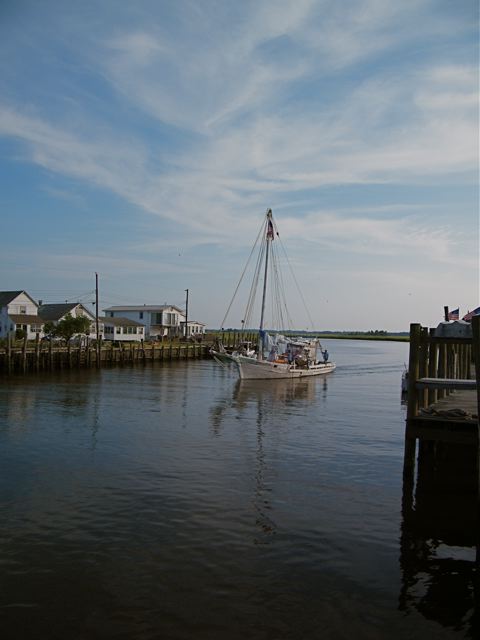
The Maggie S. Myers Coming Through the Cut from the Delaware Bay to the Murderkill River Where She Is Berthed.

July 7, 2012 — I spent the evening of July Fourth out on my friends’ 119-year-old oyster schooner, the Maggie S. Myers, under sail on the Delaware Bay off Bowers Beach, Del., eating, listening to acoustic guitar music and watching the fireworks along the coast.

Maggie Coming Through the Cut

Our friends Jean Friend and Frank “Thumper” Eicherly IV, who own the Maggie, invite a group of us out each year to enjoy the camaraderie and celebrate our nation’s independence. Last year someone on shore ended the evening by setting off Chinese lanterns, hundreds of them, that floated in the dark over the bay like spirit flames.

Freedom Flag Unfurled

My friend Robert Price, http://www.etsy.com/shop/assemblage333 shot these photos of our event this year. With his camera he created a beautiful documentation of the night.

Along Bowers Beach — Anticipation of the Show

Jean and Thumper bought the Maggie fourteen years ago, rescuing her when her former owner was about to beach her, and since have sunk tens of thousands of dollars into her each year, maintaining her and lovingly restoring her, in 2004 restoring one of her masts.

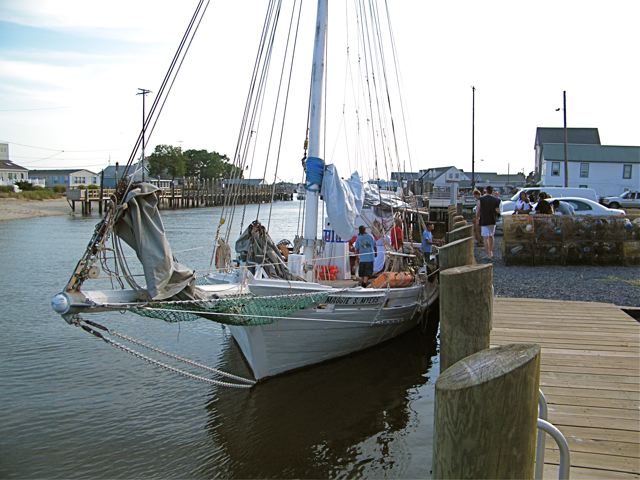
Maggie Moored Before the Cruise with the Flag Atop Her High Mast

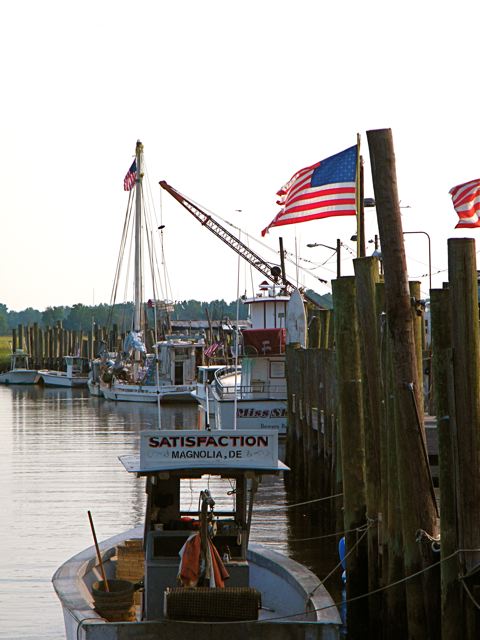
The Maggie S. Myers was built as a two-masted Delaware Bay oyster-dredge schooner in Bridgeton, N.J., and commissioned in 1893. She is 50 feet long and 18 feet wide. The 24.62 ton schooner can carry her weight in oysters. She is listed on the National Historic Register.

Maggie Unmoored on the Murderkill
Coming to Get Us at the Public Dock

The Maggie has never been out of commission. Thumper and crew work her nearly daily on the bay dredging for conch, blue crabs and oysters. She is believed to be the oldest, continuously-working oyster schooner under sail in the United States. She is living history.

Freshly Painted Lady

“She’s low to the water and dredges by hand,” Thumper rhapsodizes. “She turns on a song, like a snow goose flying around in the air.” I can tell you his claim is true; I piloted her briefly up the serpentine Cohansey River in New Jersey that early morning in 2004 on the way to the boatyard to restore her mast.

At Dock Ready for Boarding

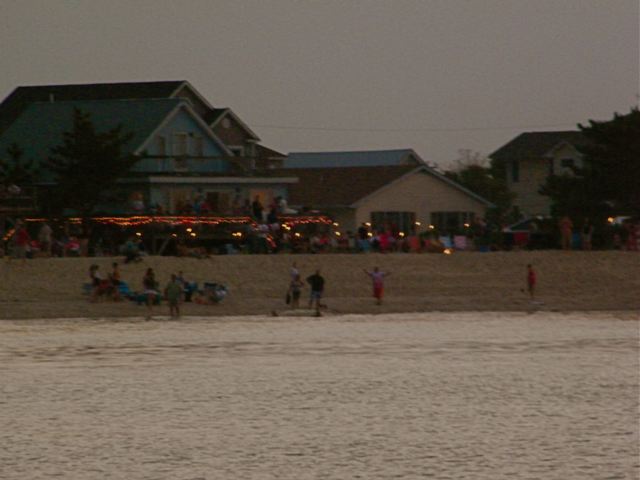
This July Fourth night it was hot out on the boat, but far more pleasant on the water than on land, with a light breeze, the water like glass. A guy with a house on the beach, and apparently money to burn, buys and shoots off fireworks every year. They go on for over an hour. Simultaneously, someone nearby again this year set off Chinese lanterns. The fireworks go on longer than displays in local cities. They are beautiful, too. Deep blues and golds and some purple along with the standard colors. People build big bonfires all along the beach. Someone on shore set off a couple of red rocket type fireworks that sailed right over the boat — over, thankfully. We were getting ready to jump. Awestruck on seeing them, I stepped back from the gunwale, stood between Jean and Thumper and said, “‘The rockets’ red glare’ springs to mind.”

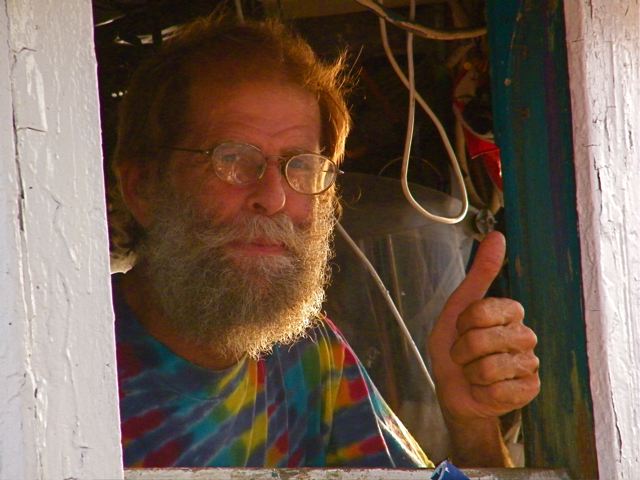
Flower Child Captain Frank Eicherly IV

We had been out on the water in the dark for a couple of hours, when a swimmer was spotted swimming the distance from shore to the boat. “Did we forget someone?” asked Jean.

Holiday Decorated Wheelhouse.
Work Table Laid with Holiday Fare.

“Throw me the ring!” he yelled. He was yet about 25 feet from the boat.

Sailing into the Sun

“He’s nuts!” said Jean in her deep, raspy voice.

Landlubbers Party Hearty

Thumper tossed out the life preserver. The crew hauled the swimmer aboard. He was J.T., another crewmember. He had hurt himself somehow and was in pain.

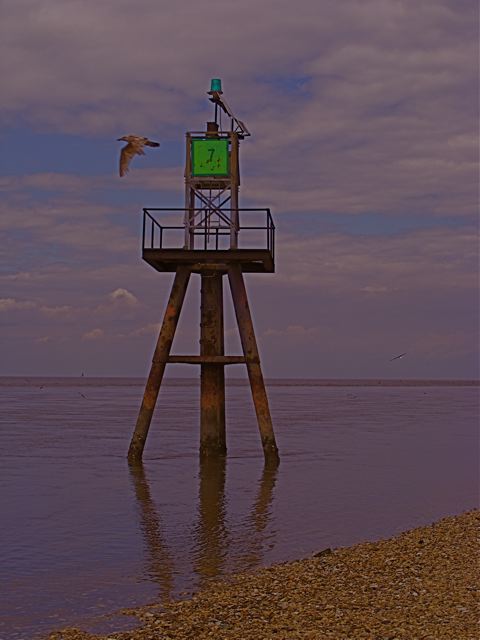
Marker 7
At the Mouth of the Murderkill

He ate, said “See ya later,” then jumped back overboard and swam to shore wearing a life jacket — hard to swim that way, but at least he wouldn’t tire and drown.

As the Earth Spins

The Maggie’s deck was laid with two Oriental rugs. Tables were laid with food. Jean supplies some of it and guests bring some. Thumper pilots the Maggie from her berth up the creek and brings her to the public dock for us to board.

Crew Looks to the West

At dock in the creek, we have to climb down a ladder (just a household four-step ladder that you would stand on to paint the walls or hang the flag from the porch roof beam) folded and leaning steeply against the gunwale and dock piling — you climb down frontwards, placing your feet on the back edge of the treads of the closed ladder, with two crew members, one on each side of you, firmly holding your hands, supporting you over the foot of black water space between the dock and the boat.

“Sing for Me”
Lonnie Fields, Delmarva Friends of Folk Member
Host of the Annual October Delmarva Folk Festival on His Farm

In order for Maggie’s five-foot draft to make it through the cut from the creek to the bay, we have to start as the tide is coming in and then return at high tide. The cut is silted in because new high-roller residents have built houses and dumped more sand on the beach.

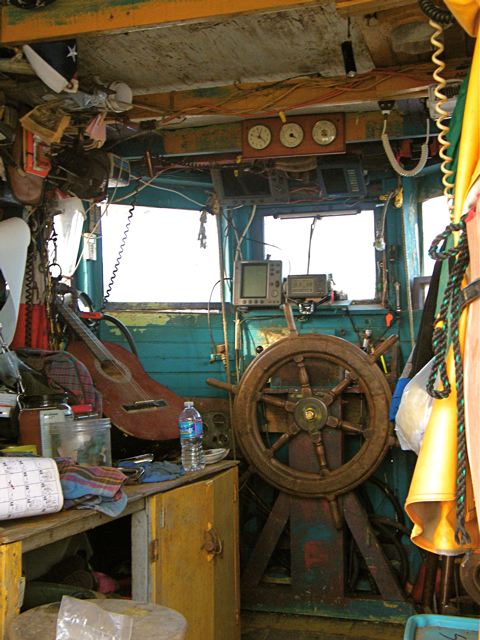
Wheelhouse Paraphernalia

After we ate and watched the fireworks two of the guys, members of Delmarva Friends of Folk, sat at the bow, played their guitars and sang the blues for us. There in the dark, a light breeze came up and a shoal of black mackerel clouds etched in silver light traveled across the full moon.

At the Helm: Captain Frank “Thumper” Eicherly

We were under sail much of the time, but barely moved since there was little breeze. Thumper used the engine to move us around.

“Masthead” — Jean Friend, Captain Thumper’s Wife

At the end of the evening, back at dock, we jumped down about three feet onto land. Crewmembers once again held both our hands to steady us.

“Garden of Jean” — Jean’s & Thumper’s House

What a wonderful, very special time. A very special annual event Jean and Thumper provide for us.

The Conch Chimney That Thumper Built

We never did find the apple pie, however, that the friends I rode with brought and carried aboard.

—Samantha Mozart

High Tide at Bowers


At the End of the Day
Working Maggie Unloading Blue Crabs


LXXVIII. The Price of Freedom


June 30, 2012 — My sister posted a large photo on her Facebook page the other day with a note to her husband stating, “I finally found a picture of myself the last time I vacuumed.” There she is, standing in front of the Christmas tree, hand resting on the handle of a small upright vacuum. She was about four years old.

This incident confirms absolutely that we are sisters. Besides being writers and looking alike, although she is 22 years younger and we have different mothers, we share many common traits.

June 26 happens to be my sister’s birthday. My Granddaddy, our father’s father, had four sisters; and they were all crazy. There are just two of us and we are completely sane; trust me on this. And until that day last week, there were four Ephron sisters. June 26 is the day writer/journalist Nora Ephron died (movies: When Harry Met Sally, Sleepless in Seattle, You’ve Got Mail, Julie & Julia; books: I Remember Nothing, I Feel Bad About My Neck; and much more). She bought her freedom from this earthly realm. But for me her death is a loss and a shock. I didn’t know she was ill. She carried her illness with dignity. Recently, she wrote about the urgency of pursuing our dreams, cautioning that we never know how much time we’ve got left. I hear her. She was just my age. Too young. Scary. I regarded her as a generational and writing compatriot: at least we could become relics together, and find the humor in it. Therein, reading her take on the condition, I would find support. She was a screenwriter and essayist of the highest caliber.

When I sat down to write this, I had just gotten done resetting all 30 digital clocks around the house after our storm last night. It seems like 30 clocks, anyhow – plus the VCR (always mystifying until I wrote and taped instructions to the back of its remote) and the digital answering machine (a greater conundrum than the VCR). I hate hearing that little man answer when I call people; I never know if I’ve gotten the right number; so I don’t know what kind of message to leave, whether to give intimate details or be so superficial that my recipient, even though we’re close, hasn’t the foggiest notion what issue I am trying to get across. Making a new announcement is user friendly; setting the date and time is the enemy.

Speaking of little men and film, I watched the movie Albert Nobbs two nights ago. It was excellent: an extraordinarily well-crafted plot, and Glenn Close’s performance rivals that of Meryl Streep’s in Iron Lady.

At the height of the storm, I watched on TV the Charlie Rose remembrance of Nora Ephron while lightning flashed, high winds shook this old, wooden house, large things blew around outside, the tall loblolly pine near my window swayed wildly towards the house, and the fire siren (on the next street) went off. Then the power went off. So, once again, Nora Ephron’s existence was cut short. I will watch the conversation online at charlierose.com. What I saw of the show was heartwarming, though: Nora Ephron makes me feel good. She has a wonderful way of finding the humor in a difficult situation; she said her late mother, as screenwriter (Take Her, She’s Mine, modeled on Nora at Wellesley College), said “Everything is copy.” I heartily agree. Therefore, I promise I probably won’t use your real name in my story.

From the storm, here in our neighborhood we received no damage, amazingly. And the town restored our power after an hour. There for a spell, though, we rode the rapids.

You have to ride the rapids at times. I have. You can’t live life in a vacuum. Life is short. Go for it. Go for your dreams. I have to repeat this to myself, like a mantra. Twenty-five years ago reside just around the corner, as close as our local library; yet 25 years hence I will be two-years short of Emma’s age when she died. That age is just up the block, over the next hummock.

Relative to writers, journalists, and riding the rapids, exists crossing rivers in high storms and dense fog to miraculously survive this life or to win a battle for independence. Our American July Fourth celebration is upon us. The older I get, the closer 1776 appears, just around the last bend, just across our nearby Delaware River into New Jersey. I have lived nearly one-third of the 236 years between 1776, the year we declared our independence from Great Britain, and today. The patriots won, and thus far we maintain, our freedom of speech. “The price of freedom is eternal vigilance.” Thomas Jefferson said. I am proud to be a working member of the fourth estate. From me, George Washington – oops, no, no, I don’t have delusions of grandeur – from our illustrious leader George Washington, who sometimes rode a white mule, and Thomas Jefferson, who lent me his “Head and Heart” love letter for my Chapter XXIX “The Overture,” freely enjoy a safe and sane Independence Day! Remember: vacuum after the party.

—Samantha Mozart


LXXVII. The Party’s Over

(You will find the soundtrack to this story in my playlist, The Dream, no. 19 – “Stranger in Paradise”, in the right sidebar.)

June 21, 2012 — It’s quiet here. It’s the time when everybody who’s been around you during the long illness and in the days following the funeral says “Buh-byee,” and one-by-one or in twos quietly wander off.

It’s going to be 98 degrees Fahrenheit today (with 300 percent humidity, of course). I have lodged myself in a small room, my studio, at my desk about 10 feet opposite the air conditioner turned on high: a good day for finishing formatting my e-book, Begins the Night Music, for paperback, to be marketed on Amazon initially. I look at the North American dogwood outside my window; its leaves are curled on the edges, from the heat and lack of rain, I suppose. In the center of the top of the tree is a tall dead branch that has grown straight up; it has numerous short-branch offshoots with twigs shooting off them, like naked, gnarled fingers reaching heavenward. It’s existed like that for a year. I wonder what happened? Kindling. Then, dust.

I get hungry, so I venture downstairs to the kitchen to see what I can fire up to eat from the refrigerator. On the way, out of the corner of my imagination as I pass by the ballroom of my blog, I see the Phantom manning a push broom with a long flat head (the broom, not the Phantom, although sometimes I wonder) like the kind the men sweeping the streets in West Philadelphia in front of my Nana’s house used when I was a kid.

“What are you doing?” I ask him. He is sweeping party hats, crepe paper streamers, confetti, paper cups and cracker crumbs into a pile.

“The party’s over,” he says, not looking up from his work.

My Hospice chaplain suggested I have a house clearing party four to six weeks after Emma’s funeral. I wondered about it; why I would need it; what would be the effects. But figuring that she, as my spiritual guide, knows more about these things than I, I gave the party June 9. The day of the party actually occurred seven weeks after, but that was the earliest I could get everyone together. And as the date drew near, I began to feel, I don’t know – the best way to describe it is empty, a bit at loose ends even though I had plenty to do and catch up on. In that final week and a half, I felt in need of a positive boost. There was a hollowness.

The party was a potluck and those who came were my closest friends, those who had been with me through the long years of Emma’s continued decline, and my Hospice chaplain, Hospice nurse – Tess, and social worker/bereavement counselor, Geri. Tess and Geri have been with me through the wars the last three years. They patiently listened to my fulminations and supported my meltdowns; they arrived within minutes of an emergency, and later they laughed with me. Together sitting in the living room eating with the two of them and my Tibetan Buddhist Rinpoche friend, among others, I could not have asked for more comforting company. Again I thought of how truly fortunate I am. The party lifted my spirits and gave me a fresh perspective on going forward; I feel regenerated; so does the house. I step outside with the last departing guests, and there, beneath my wind chimes and among my plants, lining the front of my porch boards are sand dollars, sea urchin shells along the lower rail and in the flowerbed baby blue-green horseshoe crab carapaces. Leaning against the center support post is a painted turquoise and white starfish. The angels have visited. I suppose this is the work of my friends Jean and Thumper who own the historic Maggie S. Myers Delaware Bay oyster schooner, whose story I have told here many times.

But, now, yes, the party is over, definitely over.

Fortunately I am pressed to reformat my e-book for paperback and maintain my blog. So, these activities keep me occupied.

Now is the time for me to gain a clear focus on my future, on the time remaining in my own life now that Emma is gone: to truly believe that I can fulfill my dreams. And when this angel looks homeward, she sees her love of writing. Writing is and has always been my green light across the bay. I have many stories written that I want to refine and publish and many stories to tell.

While I was working at my computer on just such, my friend R called the other day to say that he and his cousin, Pam, wanted to take me out to lunch at our local Irish pub. I walked around the corner to meet them. There we sat eating Irish stew and Irish brown bread beneath the Irish poets gazing down upon us from their photo perches on the wall – James Joyce, W.B. Yeats, George Bernard Shaw and others. Missing was Oscar Wilde; maybe he was in the other room, at the bar. I experienced a peak moment eating there at that pub among the world’s greatest writers. Capping all that I have been through the past decade and especially recent months – the experiences, the struggles, the spiritual revelations, the life changes – I did indeed at that moment feel like a stranger in paradise, as the Kismet song to Russian composer Alexander Borodin’s music goes.

The party’s over but life among the poets has begun. We must do lunch more often.

On June 2, Buddhists and nature-lovers gathered on Slaughter Beach here on the Delaware Bay for the fourth annual blessing of the horseshoe crabs. My Rinpoche friend organized the event. He notified me of it, yet as much as I wanted to attend, I felt too overwhelmed with the undercurrents in the wake of the decade-long storm assaulting my life to navigate my way clear. I told him I was sorry. He said he understood completely. Yesterday he emailed me the link to the online newspaper story about the event. When I viewed the pictures and read the story last night, I cried, sobbing in despair that I didn’t go. It was good that the Phantom of My Blog wasn’t around, for I surprised myself with my odd reaction.

In the news photos I looked at those compassionate humans out there on the beach blessing sentient beings. I thought of my bathtub centipede that I didn’t kill, but set free (albeit from a second story window); of the furry thing looking like a mouse wedged upside down last evening outside my closed kitchen window between the screen and storm window – most likely a bat (the creature is gone, now, probably having taken flight in the dark of night). I thought of the time I went out on the Maggie Myers helping to tag horseshoe crabs for the United States Geological Survey, dredging the 450 million year old species out of the bay, dumping them on deck, measuring them, recording their ages and sex, tagging them, then gently setting them onto the deck and watching them find the direction of the water and slip over the edge back into the bay; I thought of all the sea critters whose empty shells now grace the flower garden and green boards of my front porch.

I replied to my Rinpoche friend’s email telling him that I was so sorry I missed the event, that I should have made a greater effort. He emailed me back, “There is always next year.” I find his words comforting, assuaged of my feelings of guilt; yet at my age I have begun to wonder about next years.

The caring for all sentient beings is likened to the loving kindness of a mother, the Buddhists tell us. The mother of each of us nourished us in her dark womb from the time we were shapeless beings, endured the hardship of bringing us into physical form, fed us, bathed us, clothed us, read to us, taught us about life and the world and right from wrong – at least my mother did. And she was there to listen to me with understanding and compassion, there to support me, patiently sitting on a bench at Harpers Ferry, West Virginia, at 84, with her little apricot poodle, BeeGee, for two hours while I got just the right camera angle and shot for a series of photos of the historic town.

The idea is to give what one needs most – care, compassion, love. What do I know? I don’t. Yet, hopefully, others will find useful and supportive my own experiences and feelings. Like those great Irish poets gathered round me at lunch, my humble conveyance utility is often my pen—

“What?”

Oh, the Phantom of My Blog says it’s my keyboard. OK, my keyboard – the words by which I transmit the messages I hear.

Naked and alone we came into exile. In her dark womb we did not know our mother’s face; from the prison of her flesh have we come into the unspeakable and incommunicable prison of this earth. –Thomas Wolfe, Look Homeward, Angel

The party’s over: we wander off, alone or in pairs, strangers in paradise.

Samantha Mozart

LXXVI. The Men in My Life

June 16, 2012 — I have a silver-framed black and white photograph of my grandfather and his two boys, my father and my uncle, dressed in shirt sleeves and ties, sitting in rocking chairs and smoking pipes, with their dog, Tippy, at their feet on the front porch of my great grandmother’s summer home in Sea Isle City, New Jersey. The picture was taken shortly before I was born. Of our family collection of photos, this is one most significant to me. This one picture tells the story of my early life – where I was, who was with me, how I felt, what we did and why: where I came from. As I gaze at it now a movie plays across the screen of my mind.

After I was born, in the summertime Mother and Daddy took me to that house at the shore. Aunt Marguerite and Uncle Bob would be there, too, along with my grandparents and great grandmother. When I was two, on Sunday mornings I’d walk with Granddaddy to the corner store to buy the Sunday paper. I remember the bright colors of the funny pages. He held my hand. Once we thought it might rain. I held up my index finger and said, “I have my ‘brella.” I recall the scene, and I remember it because the family thought it was so cute, relating the story over and over. We often walked on the boardwalk, the whole family, of course, and Granddaddy took me for a ride on the merry-go-round. I loved that. That was very exciting for me.

Granddaddy took me everywhere with him. At home, in the Philadelphia suburbs, I often stayed at Grandmother’s and Granddaddy’s house. Aunt Marguerite and Uncle Bob lived with them. During World War II, Uncle Bob served overseas in the Army. He looked so handsome in his brown Army uniform. Granddaddy worked at the bank in Philadelphia, and, in those days, worked traditional bankers’ hours. He didn’t drive. So, in the afternoons he’d ride the bus home, get me up from my nap and take me out for a ride on a bus or trolley or the passenger ferry across the Delaware River to New Jersey. He wouldn’t waste time getting me out of the house, because we had to be home for dinner; so Grandmother and Aunt Marguerite were mortified that he’d rush me out of the house without my hair brushed. He didn’t care; he just wanted to take me with him. He had raised two boys, so I was the first girl. I remember a street corner bus stop. There were blue spruces there on the small green semicircle lawn and old shade trees; there were red-roofed structures built of gray granite; the bus would come and it was red – the Red Arrow company: they ran western suburban trolleys and buses. I remember standing on that corner waiting for the bus, holding Granddaddy’s hand and looking up at him. I loved going on those rides with him; it was an adventure; it was like going to an amusement park. With Granddaddy, I felt secure and loved.

In November or December 1943, before Uncle Bob went off to the war, we got a puppy. Granddaddy owned a black Packard, often parked in the driveway, just outside the living room double casement windows. Daddy and Uncle Bob said the chauffeur only polished the side of the car that faced the house. Uncle Bob drove us to get the puppy. Daddy sat next to him in the front seat. I sat in the back next to Granddaddy. I wore my camel snowsuit. On the way home, the puppy, a black and tan shepherd/collie mix whom we named Butch, kept sticking his paw into Granddaddy’s pocket. The family couldn’t get over that; they laughed and laughed as they retold the story.

For some time during the war both Daddy and Uncle Bob were away. Daddy served at Fort Dix, New Jersey in a desk job. He had worn glasses since he was six. Then they came home. I remember the excitement and the relief. My brother was born in 1945. Uncle Bob brought me a doll back from Belgium. I still have that doll. I cherish it.

I remember standing in the square reception hall of my grandparents’ house amidst the group of men when they were carrying on an animated conversation about some current event or the state of world affairs, listening, looking up at them. It was like standing in a copse of tall, intelligent trees. I always found what they were discussing more interesting than what the women discussed – the sacrilege of the neighbors hanging out their laundry on a Sunday or the state of the linens; how the maid twisted the vacuum cleaner hose.

In 1947 Granddaddy got sick. “Didn’t he eat his lunch?” I asked. They said he had; it was something else. Granddaddy died in October 1948. I was seven. “I’m not going to cry,” I said, though I felt bereft. I’ve never gotten over his loss. Often when I seek solace, I recall Granddaddy. He was a handsome man, too. In his younger days, he looked a bit like Jimmy Cagney.

I know a man who lost his daughter several years ago. I can’t even imagine the emptiness of that loss. Recently, he gave me the gift of music – a CD of arias. I have to close my windows when I play them because I play them really loud.

Uncle Bob and Aunt Marguerite were second parents to my brother and me. One night the four of us and Grandmother came home in the midst of a thunderstorm. The power in the house was out. In that house above the garage was a servant’s quarters, and a back hallway that led to it off the back stairs out of the kitchen. The only upstairs access to the back hallway was through a door in one of the bedrooms, the guest room where I was sleeping. Uncle Bob got a flashlight and led us into the house. Aunt Marguerite, Grandmother, my brother and I  made our way upstairs and then some spook came creeping around the back hallway with a flashlight making scary ghost sounds.

Once, before I was born, Uncle Bob took the family out for a Sunday drive. He pulled the Packard over to the curb, saying “Wait here a minute.” He walked across the street into a drug store. The family waited. A few minutes later he emerged, got into the car and drove off without a word. He told them later he had gone in and had an ice cream. The family recounted that story many times.

The boys, Bud (Daddy) and Bob, as teenagers one year decided to keep their Christmas tree up until Valentine’s Day. They did, and then put it into the fireplace to burn. Flames shot halfway across the long living room.

My brother and I stayed with Uncle Bob, Aunt Marguerite and Grandmother for two weeks when I was in high school and our parents were in the midst of divorce. At dinnertime Uncle Bob would grab the plastic ketchup squeeze bottle and make to chase us if we didn’t behave. Later, when Uncle Bob, Aunt Marguerite and Grandmother had moved to a Center City Philadelphia high-rise co-op apartment, we sat in the living room watching TV after dinner. Uncle Bob got up to get his usual evening snack. He came crawling back into the living room out of the dark kitchen with a Cheeto on each of his eyeteeth, like fangs.

I got married. Our daughter, Kellie, was born in 1967. The U.S. Navy stationed us in Southern California during the Vietnam War. We found lying on the beach in January and the outgoing lifestyle appealing, so we stayed. In 1970 we divorced. In July 1973 I had an awful foreboding. That August, Uncle Bob was diagnosed with colon cancer. He was 61. Too young: he is too young to die; I am too young to lose my uncle. I am devastated. I was attending beauty college. There, my good and spiritually evolved friend Robert M. sat beside me day after day telling me it was my uncle’s time to go: “Let go, let go,” he said. “You must give him clear passage so he can go into the light unobstructed. Let him go in love,” Robert said. I did, but I couldn’t have done it without Robert’s uplifting support and guidance. My uncle died on December 5. Daddy lost his older brother. Aunt Marguerite, who loved dogs, and told Uncle Bob, when he asked her what she wanted for Christmas, said “Something with four legs,” lost the husband who gave her an electric frying pan that year.

Daddy lived a good, long life. He was healthy and got around just fine; he mowed the lawn up until his last years. He sat on the side of the bed one night setting his clock radio for morning when he felt a sharp pain in his chest. His aorta split. He was rushed to the hospital. The next day the whole family stood around his hospital bed, my stepmom, his children and grandchildren holding his hands and telling him we loved him, gently easing his journey. He died September 16, 2004. He was 90.

Daddy spent a lot of time with us when we were kids. He was always teasing us about stuff, making us think. He frustrated me when I’d ask him the meaning of a word and he’d tell me to “go look it up.” He played catch with us, cards, checkers and other board games, and Battleship, in the days when we drew the battleship, cruisers and destroyers on graph paper, before the board game was made. He wrote coded messages for me to decipher. He repeatedly told us his favorite story, scrolling the words and sentences out slowly, setting the scene of intrigue: “It was a dark and stormy night and all of the men were gathered around the fire, when one of them spoke up and said, ‘Captain, tell us a story.’ And so he began, ‘It was a dark and stormy night …’.” He took us on Sunday drives and many road trip vacations, especially up into New England, upstate New York and Canada. He loved it up there.

He played the piano and organ. In the early years we had a black Steinway baby grand piano in our home. I’d often find him sitting at the piano, pencil in hand, writing something in a spiral bound notebook. “What are you doing?” I’d ask him. “Composing music,” he’d say. Before he was married, he played the clarinet. He wanted Granddaddy to set him up with a band, like Benny Goodman. But Granddaddy said no; he told him he should go out and get a regular job to support himself and later his family. He attended the University of Pennsylvania Wharton School and became an accountant. After dinner many evenings he’d play his records – big band or classical music. I owe to him my introduction to and my deep interest in and love of classical music.

When his eyesight deteriorated, before he had cataract surgery, he couldn’t read his two daily newspapers or historical novels as he loved to, but he could listen to music. He made boxes of audiotapes and sent them to me in California. I cherish them. What a special gift. To me the gift of music is about the greatest gift I could receive. Music is my refuge. I used to imagine when I was very young that classical music came from the spheres. Then I found out it was made by an orchestra of musicians playing musical instruments. Now I know it comes from the spheres.

After Daddy’s cataract surgery, he no longer needed glasses. He had worn them for 80 years. He loved the TV show “Seinfeld”. It was his kind of humor, mine too. He also loved the “Inspector Morse” BBC/PBS long-running series. It was his kind of cerebral drama; mine too.

We had a lot of fun together in those old days. We were always laughing. We’d have dinner at one house or the other on weekends. If there were three football games on, Uncle Bob would line up three TV sets, and we couldn’t eat dinner until half time. Daddy and Uncle Bob were avid storytellers. Somebody was always telling a funny story of the antics of their youth or about the family, or a joke, or Uncle Bob or Daddy was teasing us – my aunt, my brother or me. When Uncle Bob held our dinner plates and scooped the mashed potatoes out of the serving dish, holding potato-loaded spoon in hand over our plates, he’d ask us, “Do you want them easy or hard?”

Often when I sit on my front porch now and I see a dark-colored car full of people drive up the street, I anticipate it’s Uncle Bob, Aunt Marguerite and Grandmother “rolling in”, as they used to say. I half expect Emma to be in the kitchen cooking a roast, Daddy watching baseball on TV. But, that’s not it. Most likely it’s a big car full of guys listening to rap.

—Samantha Mozart

LXXV. The Centipede

June 7, 2012 — I spotted an immense centipede in my bathtub the other day. Immediately I adopted the Buddhist attitude of not touching it. Let it live to journey on its way, preferably far away. That was in the morning. By noon it was still there. In the early afternoon it was still there. Late in the afternoon it was still there. Soon I would have to take a shower. This thing was two feet long – well, maybe a generous two inches, with long, graceful flowing legs and feelers like a Burmese cat’s whiskers. It was about the color of a Burmese cat, too.

It was too big to wash down the drain, and anyhow, the drain is slow, so it would just float around in the tub. I could pick it up in a thick wad of toilet paper and drop it into the toilet, but, you know, sometimes they don’t go down with the flush. And then it would just be in there.

I have a writer/gardener friend in New Zealand. So, in either case, I considered that where she lives it would swirl at the drain in the opposite direction from how it would swirl here. That could be fascinating to watch. Possibly.

My third alternative would be to scoop it up in some sort of a jar — hoping that it wouldn’t escape and scurry up my arm in the process —, clamp the lid on, hold it out the bathroom window and dump it out. Later I could go out to my herb garden two stories below and find it crawling on my strawberries.

Or, I could squash it. {{{  }}}

Emma would have squashed it. Disposing of bugs never flustered her. Without hesitation she did away with them. Were she watching me analyze and dance around a necessary procedure here, I’m sure she would say I’m on my own now and I’d just have to deal with it myself. It would be like the time when my daughter was a newborn and I asked Emma over the phone long distance if babies ever stop pooping so much. She just laughed.

On my current issue, I thought of the mess if I were to squash this bug. Whatever I squashed it with – shoe sole, broom, big stick – body parts of the creature would be stuck on the bottom of. I considered my friend Jean’s advice when I told her I didn’t blow the head off of one of Emma’s nurses because of the mess I’d have to clean up: “Ya gotta have a drop cloth.”

Towards evening I returned to the tub to contemplate the fuzzy behemoth. It hadn’t moved – millipede, maybe. No, gigapede. It was alive, though, I could tell: every so often it waved a feeler.

I decided to consult my women writer caregiver friends in my Linkedin discussion group. Some of them are expert gardeners and so I figured someone might know how to deal with this thing.

Answers varied from the callous “Stomp on it!” to the wadded toilet paper method, to – the solution as to what to do with a large, brown, long-legged centipede in the bathtub came from my friend in New Zealand.

“Don’t squash! Poor little thing,” she said. “Hold a jar over, slide a piece of cardboard underneath, and scoop it up. Put it outside,….chances are nature will get it! Will it hurt your strawberries?”

No, it wouldn’t hurt the strawberries. But it would freak me out if I picked one only to discover this enormous creepy creature crawling on it, or even beneath it.

Somebody advised that centipedes eat cockroaches. A compelling argument for saving this critter.

“Centipedes I don’t mind, cockroaches I do,” my friend continued. “Luckily we don’t get these down here. Stick insects I really like!” No cockroaches – a compelling reason to move to New Zealand.

“Centipedes in the toilet! Ugh!” she said.

Another member of the group said that karmically, this centipede might be a female and remember me when it has babies and teach her babies to kill all cockroaches in the area. In our case, it’s not cockroaches, per se, but large black waterbugs. When we moved into our house 10 years ago, we had waterbugs. I called the exterminator. A short time after the exterminator had come and gone, I walked down the back stairs into the kitchen one night in the dark in my bare feet. “How’d these blueberries get all over the floor?” I wondered. I turned on the light: baby waterbugs. I called the exterminator. We’ve been relatively waterbug free ever since. But one can never be too sure.

So, now, I had to size things up. I had to act before it got dark. I went around the house searching for just the right jar. I chose a little blue one and took it to the tub. Too small. I went back and chose another. Too big. Then, a third: just the right size. Next I had to select the right piece of cardboard. Being a writer and environmentally conscious (read frugal), I save the backs of writing tablets. This piece had to be not too big, but flexible, yet not too wimpy. I found the back of a four-by-eight tablet. It still had the top on that the paper had been attached to, so it had a handle. Perfect. I opened the bathroom window wide.

Tools in hand, I approached the critter. OK, now I had to figure under which end to slide the cardboard. If I slid it under the rear, the critter might run off. If I slid it under the front, it would see me coming and scamper up my arm. I chose the rear. I lifted the jar only barely enough to slide the cardboard under, then I clamped down the jar. Then I had to ensure the jar’s being firmly clamped to the cardboard on all sides as I hoisted the apparatus to the window. I reached my arms far out the window. I aimed the jar away from me. I made sure the wind was not blowing in my direction. I separated jar and cardboard. And, down sailed Cindi the Centipede.

I got back onto my discussion board: “Success!” I trumpeted. “Mission accomplished.

“I wonder if the two-story drop hurt Cindi?” I speculated.

My New Zealand friend said, “Well done! After all, they have plenty [of] feet to land on!”

—Samantha Mozart


LXXIV. The Blue Deer

Listen to The Blue Deer soundtrack in my playlist, “The Dream” in the right sidebar. Scroll down to the last piece on the list.

June 1, 2012  — I climbed the narrow winding wooden staircase into the cupola of my blog, gripping the graying white painted walls as I went. In the small box of a place at the top I walked over to one of the rows of windows lining each side. A cobweb from a yellowing gauze curtain stuck on my forearm. I pulled a tissue from my pocket and brushed it away with other webs lacing the corners of the sill. A tiny black spider suddenly homeless scampered across the sill, over a little ramp, like a mini motorcycle jump, where the paint had chipped and down into a seam in the faded white beadboard wall. I cracked open a window. The curtain lifted on the breeze like a bird of prey from its nest. The sweet smell of meadow grass wafted to my senses, and from somewhere in the coming night a faint music played.

I stood and looked out. In the almost twilight, I surveyed the vast realm of my experiences, and thought of the path I would pursue now.

The refracted light of the setting sun colored the sky orange and before it, across the tall-grass meadow, I saw the mist rising off the broad stream. Down near the stream a bed of irises grew wild – pale purple, deep purple with white centers – they were the most striking –, pink, white, yellow, many colors. Nearby, a lone man with long, dark, reedy hair sat on the bank playing his flute.

Contemplating near and far, my gaze trailed off to the far side of the stream into the distant woods, and as the light faded I began to dream, to drift on a reverie. And then out of nowhere it winged to nest in my senses, music I had never heard: with purity and grace it came – an aria – Chi il bel sogno di Doretta, the beautiful dream of Doretta, Puccini: La Rondine (The Swallow). The aria lifted me into a spiritual space, the heart of where I stay for now.

Just there in the half-light, I felt a draft. I smelled nutmeg. Something brushed against me. I shivered.

“Ah, the music of the night,” a subtle, deep, monotone spoke. A low talker. The Phantom of My Blog. He stood beside me. He laid a deep purple iris on the sill. He smelled of nutmeg. He always smelled of nutmeg. “You shiver. Maybe you need a sweater.”

The aria ended. We stood in silence. The man continued to play his flute. We floated on the evening.

My mind drifted back to last summer. I thought of my little family that I took care of: Every morning getting Emma up and dressed; helping her step down the sixteen stairs with their narrow treads and her iron grip on the balusters; getting her to the table to eat the breakfast she once prepared for herself – orange juice, oatmeal or Cheerios with bananas, strawberries and/or blueberries in skim milk. I thought of the times I’d prepare lunch for myself and run it up the back stairs to my studio, racing Jetta who would run up the front stairs because the back stairs were too steep for her, and we’d see who got to my studio first so she could have her treat. Then Jetta got sick and I had her put to sleep. Two months later, Keats, my Valentine’s cat, showed up, coming tender on the night that cold, snowy, blustery midnight, February 9. He was a sweet, smart cat, as Jetta was a sweet, smart dog. I fed Keats a sumptuous meal Thursday evening, April 26, then let him out, saying, “Now, you be back by ten thirty.” I never saw him again. Clearly he had people somewhere – he came wearing a sage green collar and with impeccable manners. Maybe they came and found him and took him home. Then Emma got tired, so very tired. “I don’t know how I got here,” she said in her agitated state in January. “How do I get out of here?” I could see it coming. So did our Hospice team. Their attention shifted away from her and to me.

Just then an osprey circled the field and flew straight at the phantom and me, like we were in the control tower and it was coming in for a landing. The black mask across its eyes looked like the painted bands that wrap around the windshield and windows of a commercial jetliner.

“The Lone Raptor,” said the phantom, “on his wings of tarnished silver.”

The osprey came close to the window, nodded, veered off to its left and was gone.

I remembered Emma as she was, before dementia tarnished her mind. Now, five, six, seven weeks after Emma’s passing I have found myself thinking, “Hmm, here I am all by myself, no little dog, no Keats cat, no mother to care for, a house that suddenly got really big: Besides my writing, what do I do now? What is my spiritual path? My spiritual advisors tell me to continue my caregiving. How do I do that? What do I do?”

All the old thoughts stacked up on the roof of my mind like factory chimneys.

Emma loved flowers. She would have loved the flowers in our garden this year. They were exceptionally lush – yellow daffodils, deep pink tulips and pure white, fragrant yellow roses, and pale purple irises that grew as dense as trees in a forest. I looked down at the windowsill. “So, you were out picking flowers?” I said to the phantom. “That’s a beautiful iris.”

“I picked it for you,” he said. “Iris is the goddess of the rainbow, thus implying that her presence is a sign of hope, and the wind-footed messenger of the gods to humankind, according to Greek mythology. She flies upon the wind and moves like a blast of bright air.”

“Like an orb,” I mused.

I was surprised that he had thought to pick me an iris. More likely, as had been his wont I suspected he would nudge me over the sill and out the open window. I was touched by his kindness.

“Thank you,” I said.

Then, “Blue, dear,” said the phantom.

“What?”

“A blue deer. Look.” He pointed.

In the meadow, over near the woods, in a shaft of soft light, stood a blue deer, nosing the ground, foraging for food at twilight.

The wind picked up, then. The stream flowed fast on the wind with little white caps like water in a channel. The man had gone from the bank. The music continued to play, slow, meditative, but lush: now strings joined the flute – violins and deep cellos, and satiny brass, and reeds – clarinets and saxophones –, and double reeds – English horns and bassoons –, then an accompanying chorus of voices. Haunting. Where was the man with the dark reedy hair?

“He’s gone,” said the phantom, although I had not asked aloud. “The music of the spheres,” he said. “It emanates from the deer.

“The Blue Deer reminds us that we must be stewards of our environment. The Blue Deer is a dream vision, it is a dream of finding one’s spiritual path and of healing not only oneself but also the world and environment from pollution.”

“I am deeply honored by his visit,” said I.

The phantom spoke: “I vacuumed your blog for you, organized it, hung a new header and cleaned up the clutter while you were outside ruminating on the precise color of tulips, learning that the term tulip evolves from the Persian word for turban, and contemplating the greater meaning of all that.

“You tend towards understanding the realms of wisdom and healing through nature,” he continued.

“The seeds of a summer garden,” I said, “the tender green stalks upon which the caterpillar crawls before it metamorphoses into a butterfly. I’m trying to plant these seeds now.”

“Maybe you’re harvesting them,” said the phantom.

“I seek guidance,” I said, “and thus arrive the flute player, the iris, the osprey and The Blue Deer – stewards. Caregivers are stewards; stewards are caregivers.”

“You forget me,” he said. “Am I not your steward?”

“I don’t know,” I answered. “I can but imagine.”

Dusk embraced us now. The Blue Deer lifted its head, sniffed the air, and then walked off into the woods. I pulled the window shut, picked up my purple and white iris and we headed down the winding staircase, I behind the phantom. In case I stumbled I hoped he would catch me. If I went first I feared he would push me. I didn’t want to flatten my iris.

When we reached the foot of the stairs, I thanked him again. We parted there. I lifted the iris to my nose. The stem had a nutmeggy smell, like his hand.

“What is your name?” I called after him.

“Moriarty,” he called back.

—Samantha Mozart

Acknowledgements: I must thank my spiritual teachers and spirit guides, and the following creative souls for inspiring the vision of this piece: My extraordinary new group of women writer caregiver friends; T.J. Banks, award-winning author, “Sketch People: Stories Along the Way” and more (find her on Amazon or click on the links on either sidebar here); Philip Glass, composer – Symphony No. 7, “A Toltec Symphony”: 3. “The Blue Deer”; and “Passages”; Coyote Oldman, their album titled “Floating on Evening”, Charmayne McGee, author, “So Sings the Blue Deer”; http://mythagora.com/ for the story of the Goddess Iris; Sir Arthur Conan Doyle; and, of course, Gaston Leroux for his “Le Fantôme de l’Opéra. And, oh, Puccini; how could any woman forget Giacomo Puccini?


LXXIII. Mirror, Mirror …

May 25, 2012 — I got up the other morning and greeted myself in the bathroom mirror. The t-shirt I had been sleeping in said “RATS.” Then I realized the shirt really said STAR, the name of the groomers who used to groom Jetta, our teacup poodle. So, my day got better.

—Until dinnertime when I reached into the refrigerator and pulled out the bottle of René Barbier Mediterranean White Catalunya to have with my flounder. The bottle must have a leak in it or something, for there remained but a sip. I hadn’t touched that wine since my daughter Kellie was here and my friend Jackie came over. I don’t know what happened…. That was the day we assembled the bookcase and then indulged in piles of crackers, gourmet cheeses, protracted conversation, Kellie’s iPhone Pole Barbie photos and a little wine. (See Chapter LXIX: Pole Barbies.)

I emailed my friend who turned me onto this wine about my situation.

“I think the bottles are defective,” she wrote back. “I have the same problem.”

My friend and her husband own a Chevy S-10 pickup truck, and they have graciously offered to let me use it whenever I need it.

I needed some clothes. My guess is that the shops lining Melrose Avenue in West L. A. are located beyond the fringe of where my friends would have me drive their truck. So I drove to the local mall. That in itself was culture shock: Having been confined to home most of every day caregiving for Emma and without a car, I hadn’t been to the mall in nearly two years.

As I declined brochures and fliers from hands outstretched like toll gates from every kiosk along the way, and stepped from the mall concourse into the perfumed chamber of Victoria’s Secret, a salesgirl popped up in front of me as if magically underwired: “What can I help you find today?” I told her I was looking for a bra. “What size are we wearing?” she asked ebulliently.

“We!” I exclaimed. “I hope it’s not we, but just me!” I was looking for something more substantial than would fit a Pole Barbie body, something, shall we say, for a person who eats. Anyway, they didn’t have anything in my wallet size. I would have found it uplifting, had they. (Couldn’t resist that one.)

Then I tried on some blouses in a department store dressing room. When will department stores stop using garish overhead lighting and funhouse mirrors in their dressing rooms? Next they’ll thoughtfully provide scales. I scanned the upper walls and corners, truly hoping no camera lurked in there. You’d think they’d create an atmosphere to make you actually want to purchase that thing you’re trying on – you know, like candlelight and wine.

On the way home, I stopped at the liquor store to pick up some Catalunya. My friend orders it by the case from this store. The owner was there and he knows me.

“Do you have any Catalunya?” I asked.

“Wait a minute,” he said, and he disappeared into the back room to emerge carrying a bottle of Catalunya. He handed it to me.

“Is that from my friend’s stash?” I asked.

“Yes,” he told me.

“Not only has she graciously lent me her truck,” I told him, “but now I’m using it to dip into her wine stash.”

We laughed. He agreed with my friend and me that the bottles probably do leak. I paid for my wine and left.

I drove home, carried my acquisitions into the house and put them away, stashing the Catalunya in the fridge. Then I drove over to my friend’s place and dropped off the little truck. On the way out I encountered her walking along the sidewalk.

“Thank you so much for lending me your truck,” I said.

“It’s yours to use anytime you need it,” she said.

“Maybe you’ll change your mind when you find out I’ve dipped into your wine stash,” I told her.

“I kno-o-o-w,” she said.

“Oh, you were there right after I was?”

“Yes,” she said.

I can only reflect.

—Samantha Mozart

LXXII. The Downsourced


Saturday, May 19, 2012 — I received an email this morning from Amazon Kindle Direct Publishing congratulating me that my e-book, Salmon Salad and Mozart: A Dementia Caregiver’s Journal, Volume I: Begins the Night Music is published for readers to purchase here.

Sure enough, it’s there. Published a year exactly from the day I started publishing this blog.  If only I could have just clicked my heels and had the book magically finished weeks ago. It happens, though, that after a month of being misled in a dizzying circle trying to get my table of contents to link to the actual contents, an Amazon KDP employee stuck his hand into my book draft saved on the KDP website and tinkered with my html/web page document mutilating my table of contents formatting rendering it unrecognizable. (Pardon the terminology, but I just got done watching The Girl with the Dragon Tattoo, the David Fincher version.) Moreover, he emailed me – the KDP guy, not David Fincher – that he had reformatted my Word document. Where did he get the Word document without downloading my book file into his computer and converting it to Word format? Mind you, I have copyrighted my book with the United States Copyrighting Office. Isn’t what he did illegal? To understate my reaction, I was livid. I emailed him my feelings in all caps, large type. Thank the goddesses I saved a copy of the final draft in my computer. I immediately went to my KDP Bookshelf site, deleted his handiwork and uploaded a fresh, current copy. Then I proceeded to submit the book for publication.

Yesterday afternoon while I was finalizing my publishing details, something was going on under the trees in the forest. When it was done, I received an email of explanation, this one, from Amazon’s Executive Customer Service office, the KDP Wizard, telling me that the reformatted content (that I had deleted) had not been published and that she had now removed it and reuploaded the Word document I had originally saved. I wonder what document that was….

Since there is a two or three day delay between my emailing KDP and their reply, I suspected she had deleted the Word document I had uploaded, my final version. I clicked on the Kindle Previewer on my KDP Bookshelf site and saw – blank pages. I uploaded a fresh copy of the final version, clicked on Previewer again and saw – blank pages. Furthermore, the site now tells me that my book is in review, rather than having been published.

Throughout this month of stumbling amid sweaty entanglements of elephantine vines in the forest, I have been dealing with KDP people all of whom are sitting on their divans in their living rooms in India gazing into their crystal balls: I get emails that say, “Ah, I … see … in your document … that …” you need to change this to that. Means of phone contact does not exist. The next email would say to change that to this or possibly to the other thing. The KDP website instructions tell you to save your Word document as a web page, zip it and upload it. I did that while at the same time sending my Word document to another Amazon Kindle site to be converted to Kindle format and then downloading it into my Kindle so I could see how it looks.

Ultimately, this week the Wizard told me I could simply upload my book as a Word document, what I suspected last month.

Amazon has come under fire for utilizing such exotic hirelings. Overall, their customer service is superb, among the best; during all this crystal ball gazing, one sales supervisor, who knew nothing about Kindles, listened to me on end, sympathetically, and a few days later made a follow-up call to me. He did give me the email address to the executive customer service office.

No matter the place, the hirelings can be right here in the U.S. – the Downsourced. These are the people who never managed to graduate from kindergarten, apparently, who cannot read, write, do numbers, type – or listen; they cannot do anything but text. But they can be paid less. I just wanted a simple number from one young girl and she just could not seem to get it together beyond arguing with me. “Don’t argue with me,” I admonished. “I’m NOT arguing with you,” she said.

In my day, which was about a year ago, to get hired we had to take tests in English, math, IQ and personality – at least I did; maybe they saw me coming and got wary.  It’s hard not to outright insult these — the Downsourced — over the phone; but, then, they wouldn’t get it, anyway.

They are the Downsourced, the petty tyrants, and we are their Downtrodden.

Too bad these companies don’t realize that good customer service brings them business. Since my daughter became manager a few months ago of the health food store where she works, due to her endearing personality, sales expertise and product knowledge, she has increased sales and brought back former customers. No one wants to shop where customer service personnel treat you disrespectfully; those stores lose business and then close. It is my intuition that people who treat me disrespectfully disrespect themselves.

As for downsourcing, possibly I could get a job with Amazon KDP, lazing on my living room couch pulling cue cards out of a hat – for the low pay, it couldn’t require that much effort.

—Samantha Mozart


LXXI. Mother’s Day

Monday, May 14, 2012 — Last year, as every year, I gave Emma a Mother’s Day card. Even though I picked one with a big picture of colorful flowers on it and a simple verse, when I showed it to her and read it to her, it didn’t much register. This year, I received a message from her.

Emma’s healthcare aide Daphne came by on Mother’s Day and brought me a card. It is a pretty pink card bearing a message saying in part, “Your love is a rare and beautiful gift and there’s no one who shares it like you.” How thoughtful and touching.

Then Daphne told me that the night before Mother’s Day a message flitted into her mind. She felt compelled to write it down. Without pause, she went straight to her room, shut the door, and the words just flowed from her pen onto the small piece of paper. This is the message:

To: The Listeners

I am a new butterfly in heaven town. I will be on the trail checking in on everyone! So now and then I will be by everyone’s side. Just remember Family and Friends are most important. So strive through thick and thin. And when you get down and out just imagine a one of a kind butterfly ever so beautiful. And know that someday you too will get your wings in due time. So the next time you see a butterfly it might just be me flying around to check in on everyone!

Lots of love,
xoxo’s Emma

After Daphne wrote down the message, she tucked it into my card. Then she heard an odd sound. It was a fluttering. She looked up and there fluttering around her light fixture was a small butterfly. Daphne went to the butterfly. It had singed the edge of its wing. She turned off the light. The butterfly landed on Daphne’s index finger, glommed on and wouldn’t let go. Daphne walked around with it. She couldn’t pull it off; she might pull off a wing.

The butterfly held fast to Daphne’s finger just like Emma had held fast to Daphne’s arm, glommed on, when Daphne was turning her in bed. Emma was so afraid she’d fall, even when in bed.

Emma loved her gardens of flowers, especially the roses. And she loved butterflies.

Daphne put the butterfly in a jar giving it air and showed her son, 11. Her son had come to our house sometimes and helped Daphne take the last photos of Emma. “It’s a moth,” her son said before seeing the winged creature. When he peered into the jar, he saw that it was a small butterfly.

Then Daphne took the butterfly outside and set her free.

–Samantha Mozart

"Butterfly" Watercolor by Emma

LXX. Where Am I Now?

May 4, 2012 — My friend R emailed me this photo he took of a place he visited recently. The caption read “Where Am I Now?” I was disconcerted to learn that he had gotten lost. I hope he found his way out, because hours elapsed before I read his email. He could be floating behind one of those medusae. On closer inspection we might see his face and hands plastered up against one, peering out at us.

Where Am I Now?

Clearly, this is an 1890s spaceship that ran out of oats and couldn’t take off once it landed. The careful viewer will observe the wheelhouse on top, indicative of the purpose of the contraption. I think R sent me this photo because he believes I was around then and therefore could identify it for him.

He believes I was rolling hoops across the stage at Ford’s Theatre the night Lincoln was shot. I will let that premise rest with the ages, or the angels, whichever that may be.

My fellow blogger, http://lameadventures.wordpress.com/2012/05/04/lame-adventure-304-annual-day-of-dread/, encountered today, as her blog title would suggest, her birthday, just 17 years shy of her 70th, she reports. I am shy of my birthday, too, because it coincides with the number of this blog chapter – LXX.

I would like to tell her that the next 17 years will imperceptibly crawl across her course at a garden slug’s pace. But, why should I when those lost years flashed by me like a silver bullet. Well, look, at least she doesn’t match in age her blog chapter number – CCCIV.

Emma and I had a long ride together. The last years weren’t what we had hoped, but we did our best. Her horses were wearing out. And, after all, when she left us, she was XCVII, and even after she had lived that many years, the 1890s spaceship would have been before her time.

Yes, this building dates to before Emma’s time and before my time – MDCCCLXXXVII, to be specific. Aren’t we glad we didn’t live at the time of the ancient Romans? It seems a lot of work, plus think of all the horsehide parchment it would use up, to write a simple 1887. Besides, in my experience, Latin is not an easy language to learn.

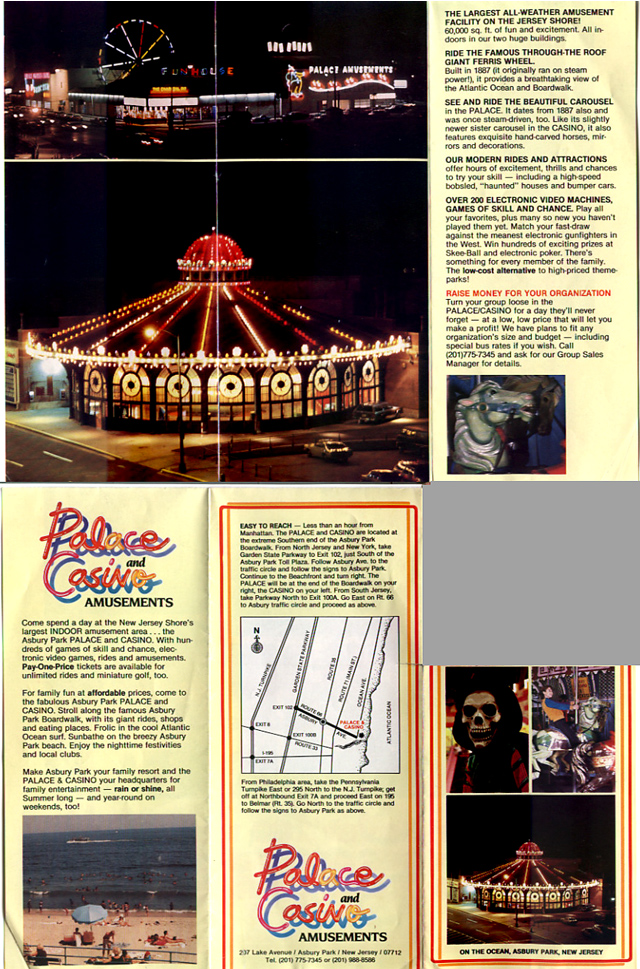
Despite its erection before our time, Emma and I, indeed, our entire family enjoyed happy times inside this lacy, filigreed, flowered affair with its medusae and magnificent architectural art, a time capsule, as it were, the abandoned carousel pavilion in Asbury Park, N.J. When, in the 1980s, the owner could no longer afford the upkeep on the carousel, he tried to sell it. A nonprofit group tried to raise funds to buy it intact. They came up a few hundred thousand dollars short and the owner stood firm. Tearfully the group witnessed some of the carved horses sold one by one at Sotheby’s auction. The pavilion stands abandoned today. That carousel was considered one of the most beautiful in the world, built in about 1910. Adroitly carved horses and other animals stood or rode up and down, four abreast. I can attest to this. It was a big one, a genuine, first-class merry-go-round. I loved riding it. I always liked to ride the outside horses: they were bigger, and I loved trying to catch the brass ring; I loved the music of the calliope, too, and hearing the drum and cymbals every time you rode past the little open door displaying the mechanisms at the center. It is sad. It was a beauty, a classic. Among the best amusement park rides I enjoyed in my childhood.

I spent many happy times in Asbury Park as a kid, in the late 1940s to early 50s. We may still have the family photos somewhere. I remember the deep blue ocean and the huge waves, looking more like a California surf; the coast drops off steeply there, not like the South Jersey shore with its gradual slope. In Asbury Park they roped off the swimming area so people couldn’t go out too far  and get swept away.

I spent many happy times in the funhouse, too, the spooky part and the funhouse mirrors – the mirrors will always feature prominently in my memory. When you went to Asbury Park, you had to stand in front of those funhouse mirrors. The Ferris wheel, too, was the best – so high you could see all over Asbury Park and the seats had to be caged.

My little brother, Bobby, often asked, “Daddy, are we going to Raspberry Park?”  Daddy would take us there on a Saturday or a Sunday.

For me, this photograph of the carousel pavilion evokes the music of the calliope, the whir of the merry-go-round on its axis, the sounds of gleeful laughter, the breakers crashing against the shore, all riding abreast the pungent aroma of salt air, popcorn, cotton candy and creosote from the sun-warmed pilings supporting the boardwalk.

The shore played prominently in the lives of generations of our family, both sides.  We spent much of every summer there. My grandfather and uncle commuted weekdays between work in the city (Philadelphia) and our summer home at the shore.  That is why when the Navy took my husband, daughter and me to Southern California during the Vietnam war, I couldn’t understand why anybody would want to live as a flatlander when you could live at the beach in that kind of temperate year-round climate with that beautiful coastline.

Where is the Asbury Park merry-go-round now? Here is its story: http://www.palaceamusements.com/sothebys.html. Here it is illuminated at night: http://www.elvision.com/asburypark/apbrochure-back-web.jpg. A medusa — is that you, R?: http://www.flickr.com/photos/army_arch/4727322120/in/photostream/

Where am I now? might be a question my visitor cat, Keats, is asking. Thursday evening a week ago, after his sumptuous dinner of dried grilled-flavor cat food and a teaspoon of canned grilled chicken, I let him out. “Now, be home by ten-thirty,” I told him, as usual. I have not seen him since. He kept a fairly regular schedule coming and going. I miss the little fellow. My hope is that, since he came to me wearing a collar and with impeccable manners, clearly much loved, that he has returned to his original family. Or maybe he is busy modeling. This sure looks like him in this picture below.

Keats?

Possibly his people moved, he got away and finally they found him. That happened with our gray shorthaired cat, Muffet, when my daughter, Kellie, was a teenager. On moving day Muffet went out the door and disappeared. We looked all over the neighborhood and couldn’t find her. We returned many times, we asked neighbors, we put up signs. Months later Kellie returned to the neighborhood and a friend said, “I saw your cat.” She was living two doors down from our former house. We picked her up and took her home with us.

Keats, I think, was playing the field, maybe with a special mission to stay with persons who need a companion, and then when all is well, moving on to the next.

Where am I now? I have disembarked from the merry-go-round of caregiving, yet I remain involved as an advocate, listening to others, sharing my experiences, giving them guidance, finding them help in what small ways I can.

I believe, though, that I would spend one hundred dollars, maybe two, just to rent a car for a day, hop into it, and drive to Asbury Park just to ride that merry-go-round one more time.

On April 6, 1971, reminiscent of Asbury Park, I composed this poem:

Ragged Days

Only a specter,
I stumbled into
An abandoned amusement park,
Over haunted relics,
And the dizzying merry-go-round ride
Of those ragged days:

Through cobwebs of disenchantment
I groped, to uncover
Half buried in dust
The scattered fragments
Of a long-ago shattered
Funhouse mirror.

—Samantha Mozart

LXIX. Pole Barbies


May 1, 2012 —  I have lived the life of someone else for nearly a decade. That life was Emma’s, organizing her finances, her pension and Social Security, her doctors, her medications, her healthcare aides and communicating with her friends: not much time for recreation. Emma lived her own life – fashion model, secretary, toy poodle breeder, artist, hostess, traveler. Now she is gone – off on some journey, and I experience the sensation of awakening slowly from a dream.

Thank goodness my friends and family are around to connect me from the past perfect (before Emma became ill) to the past tension (Emma’s protracted illness) to the present – oh, wait, I don’t have to take Jetta out, prepare for an aide to come this morning, put medications into a little dish, launder Emma’s bed sheets.

I have one close family member linking me all the way back to the far distant past, to my Mattel employee days of the late 1960s when I was listening to Joan Baez and Beatles music. That is my daughter, Kellie. Then Emma was not much older than Kellie is now. Kellie was younger than my two granddaughters are now. I used to bring her home toy samples. Gentle Ben was her favorite. I worked in Mattel’s Dolls and Hot Wheels Product Planning Division and then later in sales. In sales, one of my roles was dressing the Barbies, preparing them as models and for their glam shots for the sales catalog the buyers from department stores such as Sears would see. As an adult with hands the size of palmetto palm fronds, I begrudgingly bent, twisted and stuffed those Barbie arms into the sleeves of those tiny little dresses. At least it was easy to figure out where the dress went and where their shoes went.

Today, department stores, offering their quality apparel, furniture, fine linens, china, crystal, silver and other items, the stuff of Emma’s generation, sold by refined sales personnel, are relegated to the past. Big box stores replace them, vending their cheesy wares, rung up by inconvenienced employees.

Just so, there was the fifteen-dollar build-it-yourself bookcase Kellie and I bought in the flat box at Walmart the other day, while she was staying with me after Emma’s funeral. For something made out of cardboard, like the backing you’d find on a writing tablet, and particleboard, the box sure was heavy for having only three shelves and being as tall as a five-year-old. Kellie carried it for me. She brought it into the house and we took the pieces out of its box. We sat there in the middle of the living room floor staring vacuously at boards, piles of little screws and nails all around us and an instruction sheet of drawings only, no text, clearly missing the step 1 1/2.  My friend Jackie called.  She had recently restored the historic building she bought downtown, almost single-handedly, with a little help from her dad.  “Do you mind if I come over?” she said.  “Come quickly,” I implored.  She facilely laid all the pieces out in order, pointed to what got screwed or nailed to what, and I followed suit, hammering and screwing everything together with the hammer and screwdriver from the toolbox my stepfather gave Emma when they got divorced in their 70s.

After assembling the bookcase, we indulged in piles of crackers, gourmet cheeses, gallons of wine and protracted conversation.

Midway through the wine, Kellie showed us her series of iPhone photos, demonstrating that she is much better, with the help of my two granddaughters (The Three Kellies), at arranging “Pole Barbies” than bookcase parts, uninspired by Miley Cyrus’s pole dance at the Teen Choice Awards. Utilizing the girls’ vast Barbie collection, they had placed their undressed Barbies around and among their staircase spindles and lounging along the upstairs banister, in provocative positions.

Pole Barbies

Ah, the pleasures. Life goes on.

—Samantha Mozart

LXVIII. The Butterfly

Monday, April 23, 2012 — Today the dogwood tree outside my window blossoms, a mantle of white sheltering its branches. White tulips in our front flower bed raise their angel bells to heaven, the irises don their purple scarves, and the rose bushes lift hundreds of yellow buds like candles to the sun. Emma is gone. In her physical form she will not see these, some of her favorite things. We rejoice that she is released from her long suffering.

She passed peacefully Wednesday afternoon, April 11. Her Hospice nurse, Hospice chaplain and I stood by her side. Moments before Emma passed, our Hospice chaplain touched the center of Emma’s forehead with frankincense and myrrh oil that she had brought from Israel. I touched her shoulder and laid my hand upon hers. Our loving thoughts were of comfort and peace, to ease her along her way, to let her know she is OK, to offer her clear choice of passage to her next journey, next lifetime. She is aware that she is out of her body now, I am told by a spiritual teacher friend, and in a strange new place, like a dream state, which may make her feel a bit uncomfortable. My friend said that when our consciousness enters this new place we are given choices as to where to go next; we tend to gravitate toward the familiar. Meanwhile, too, she has been here with us, her family.

After her passing I sensed Emma’s presence here in our house in Delaware as have my brother and my daughter down in North Carolina. My daughter, Kellie, having fallen asleep beside my younger granddaughter, awakened around three in the morning to see a white light, an orb, dance in a partial figure eight in the room and then vanish. Then their chihuahua, in my older granddaughter’s bedroom, barked briefly. The next morning, in their car on their way to the school bus, my younger granddaughter, 8, sitting next to Kellie, looked behind her, then turning to Kellie, said, “Mom … who’s that woman sitting in the back seat?” When she turned to look back again, the woman was gone. “She looked like Grandmom,” said my granddaughter. “She was dressed in blue.”

The burial outfit I chose for Emma is blue. My granddaughter did not know of my choice.

Friends phone, send notes, and stop by bringing food. I serve the food using Emma’s plates and utensils. All of the things here in this house are hers, things that meant so much to her, the furniture, the service she thoughtfully chose and delighted in displaying to entertain her guests at luncheons and dinner parties. Ever the lady, she was sweet, charming and smiling.

Emma’s memorial service was composed more of music than speaking. It was what I wanted; I think she would have, too. Two of our friends and our Hospice chaplain spoke. The messages were uncannily appropriate to our family, about things the speakers could not have known; they were to the point, filled with wisdom and love. A friend played his guitar, sang two songs and offered a brief prayer; then our Hospice music therapist played her guitar: She sang a song cycle we had chosen together – Buffy Sainte-Marie’s “Until It’s Time for You to Go,” changing the words to suit mother and daughter; Willie Nelson’s “Angel Flying Too Close to the Ground;” and Bob Dylan’s “Forever Young.” To conclude the service she returned and sang the Gounod “Ave Maria” transitioning into the Schubert.

Our healthcare aide Daphne put together a beautiful DVD documentary from photos of Emma’s life, and we displayed some of her watercolors. The butterfly was the theme of the service as it appeared to be the theme of Emma’s life. She had images of butterflies everywhere, on her clothes, around the house, and created one in watercolor. It didn’t surprise Kellie, my brother Bob and me, therefore, that each of us sensed her absence at the service. In fact, as I greeted guests before the service, it took me a while to realize that the casket was there in the room with us, at the front of the funeral home chapel, and that a beautiful spray of flowers, dotted with a few yellow roses, as I had requested – her favorite flower – draped it: “She’s not here,” I thought. “She’s just not here.” And, so, like a butterfly, she had flitted among each of us in her family, the flowers of her life – her children and her grandchildren – to see what we were up to and to make sure we were all right and then gone on her way, true to her character.

Emma’s burial service in the cemetery on the hill overlooking the city and rows of roofs and chimneys of surrounding boroughs was tender on a warm, sunny spring day and brought her body to rest, with her family, just blocks from where she had grown up in West Philadelphia.

I will continue writing here of Emma’s and my journey together and of other thoughts and adventures.

Meanwhile, Emma, safe travels. May you, my mother in this lifetime, journey in peace and love.

—Samantha Mozart